# Niche Affiliate Marketing: How to Choose Your Niche.
> Niche affiliate marketing starts with the right niche. Score yours on five tests, vet the programs and disclose links properly before you build.
Source: https://scayverstaging.1wp.site/blog/niche-affiliate-marketing/
A plain guide for business owners and creators who want to choose and test an affiliate niche before spending time or money on a site.
Start reading [All articles](https://scayverstaging.1wp.site/blog/)
**Written by**
Scayver
**Published**
30 July 2025
**Reading time**
14 min
Niche affiliate marketing means earning a commission by recommending products to one narrow audience. To choose your niche, score each idea on five tests: demand, buying intent, program depth, competition you can beat and your own expertise. Pick the one that passes all five, then test it for 60 days before you build more.
That order matters. Most guides start with a list of “best niches” and work backward. A list can’t know what you understand, who you already serve or how crowded the search results are for you. A short scoring method can.
This guide is written for business owners, solo experts and creators who already know a subject well. You’ll see how the money flows, then score a niche, check demand for free, vet programs, disclose links and run a small test. You won’t find income promises here. Nobody can honestly make them.
## Niche affiliate marketing and how a sale pays you.
Affiliate marketing is a deal between you and a business that sells something. You recommend its product with a special tracked link, called an affiliate link. When a reader buys through that link, the business, called the merchant, pays you a commission.
A niche is a narrow topic with a defined audience. “Fitness” is a market. “Strength training for older runners” is a niche. You can narrow further into a sub-niche or a micro-niche, such as one type of equipment for that same group.
Here is the path of a single affiliate sale.
1. **A reader has a question.** They search for help choosing a product or solving a problem.
2. **Your content answers it.** A guide, comparison or review explains the options honestly.
3. **They click a tracked link.** The link records that the visit came from you.
4. **The merchant makes a sale.** The reader buys on the merchant’s site, not yours.
5. **You earn a commission.** The merchant pays once the sale is approved under its program terms.

Many merchants run their programs through an affiliate network, a platform that handles tracking and payments for many brands at once. Others run their own programs directly.
### The three common commission types.
Programs pay in different ways, and the type changes how you plan content.
- **Per sale.** You earn a share of the order or a fixed amount when someone buys. This is the most common type for physical products.
- **Per lead.** You earn when a reader takes an action short of buying, such as booking a demo or requesting a quote.
- **Recurring.** You earn every billing period while the customer keeps paying. Software and memberships often work this way.
Each program sets its own rates, and those rates change. Always read the current terms on the program’s own site rather than trusting a figure quoted in a blog post, including this one.
## Is niche affiliate marketing a fit for your business?
Affiliate content works best as a side stream that grows out of what you already know. It rarely works as a quick fix for a slow month. It takes steady writing, honest testing and patience while search engines learn to trust the pages.
It tends to be a good fit when these are true.
- You already answer the same buying questions from clients or followers.
- You use and trust tools or products that your audience also needs.
- You can publish helpful content on a regular schedule for at least a few months.
- The recommendations sit comfortably next to your own services and don’t compete with them.
It tends to be a poor fit when these are true.
- You’d be writing about a topic only because a list called it profitable.
- Recommending products could confuse clients about what you sell.
- Nobody on your team has time to keep pages accurate as products change.
One misconception deserves a direct answer. Affiliate income is often sold as passive. In practice, prices change, products get discontinued and programs update their terms. Someone has to keep checking. Plan for that work from the start.
## A five-test scorecard for any niche idea.
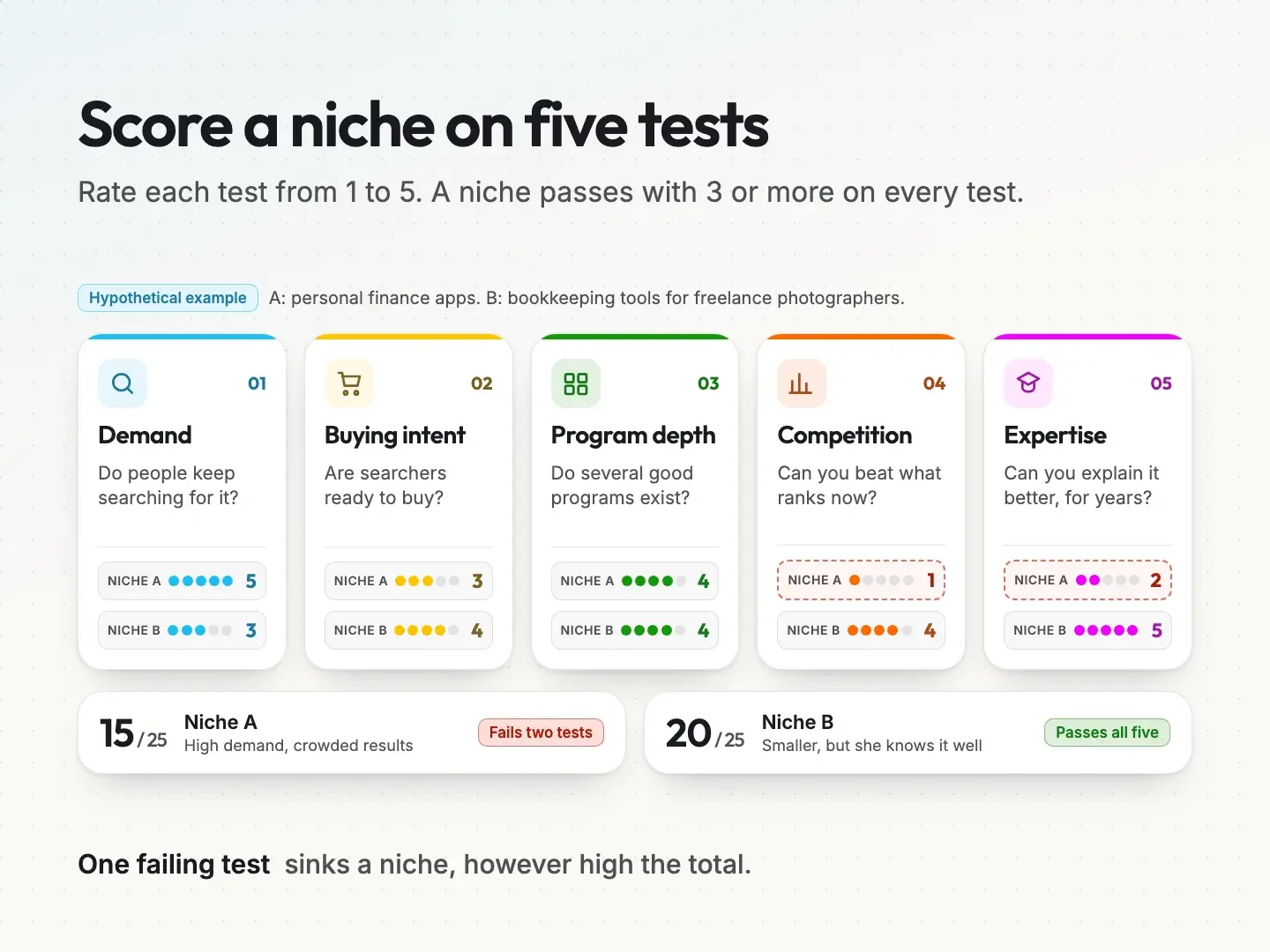
Write down two or three niche ideas. Then score each one from 1 to 5 on the five tests below. A niche passes when it scores at least 3 on every test. A high total with one failing score is still a fail, because one weak spot can sink the whole site.
### Test 1: Is there steady demand?
Demand means people keep searching for the topic over time, not only during one viral week. You want a subject with a steady or slowly growing level of interest. The next section shows how to check this for free.
### Test 2: Do searchers show buying intent?
Buying intent means a search comes from someone close to a purchase. Searches like “best”, “versus”, “review” or “for beginners” usually signal it. A topic can have plenty of curious readers and still produce few buyers. Look for the questions people ask right before they spend money.
### Test 3: Are there enough good programs?
Program depth means several trustworthy merchants offer affiliate programs for the products your readers need. One program is a risk. If it closes or changes terms, your income stops. Aim for at least a few options, and prefer products you would recommend even without a commission.
### Test 4: Can you beat the competition?
Search for your main questions and look at who ranks. If every result comes from a huge publisher or the brands themselves, a new site will struggle. If you see thin pages, old posts or forum threads, there’s room for a better answer. Low competition alone isn’t enough, though. It only counts when demand passes too.
### Test 5: Do you have expertise and staying power?
This is the test most lists skip. Can you explain the subject better than a generic writer could? Would you still want to write about it in a year? Your real experience is what makes affiliate content worth reading, and Google says the same thing about affiliate pages, as covered later in this guide.
### A worked example with two niches.
Here is a hypothetical example. A bookkeeper who serves freelance creatives is comparing two ideas. The scores are illustrative judgments, not research findings.
| Test | Niche A: personal finance apps | Niche B: bookkeeping tools for freelance photographers |
| --- | --- | --- |
| Demand | 5 | 3 |
| Buying intent | 3 | 4 |
| Program depth | 4 | 4 |
| Beatable competition | 1 | 4 |
| Expertise and staying power | 2 | 5 |
| Total out of 25 | 15 | 20 |
| Result | Fails two tests | Passes all five |
Niche A has more demand, but the search results are crowded and the bookkeeper has no special insight there. Niche B is smaller, yet she already answers these questions every week. That is why “the best affiliate niches” can’t be a universal list. The right niche depends on the person scoring it.
## Free ways to check niche demand.
Paid SEO tools are helpful, but you can learn a lot for free. Run these checks for every niche on your shortlist.
1. **Look at the trend line.** Enter your main topic in Google Trends. Its [help page on Trends data](https://support.google.com/trends/answer/4365533) explains that results are scaled from 0 to 100 to show relative interest, not raw search counts. Use it to spot steady, rising or seasonal topics.
2. **Check your own search data.** Search Console is Google’s free tool for site owners. If you already have a website, open its [Performance report](https://support.google.com/webmasters/answer/7576553). It shows the queries, impressions (how often your pages appeared in results), clicks and average position for your pages. Related questions you already appear for are a strong starting signal.
3. **Read the autocomplete suggestions.** Type your topic into Google and note how searches finish. Then check the “People also ask” box. These show the exact wording real people use.
4. **Read forums and reviews.** Look at community threads, Q&A sites and product reviews in your niche. Repeated complaints and questions are content ideas with built-in demand.
5. **Write the question list.** Collect 20 or more real questions. Mark the ones with buying intent. If you struggle to find 20, the niche may be too narrow.
Trends shows relative interest, so two topics can show the same line with quite different real volumes. Treat these checks as direction, not precise counts.
Scayver Graphix builds this kind of research into [content strategy](https://scayverstaging.1wp.site/services/marketing/content-strategy/) work for clients, so the topic list starts from evidence rather than guesses.
## Affiliate program terms to check before you join.
A good niche with poor programs still fails. Before you write a single review, read each program’s terms page in full. Check these six points.
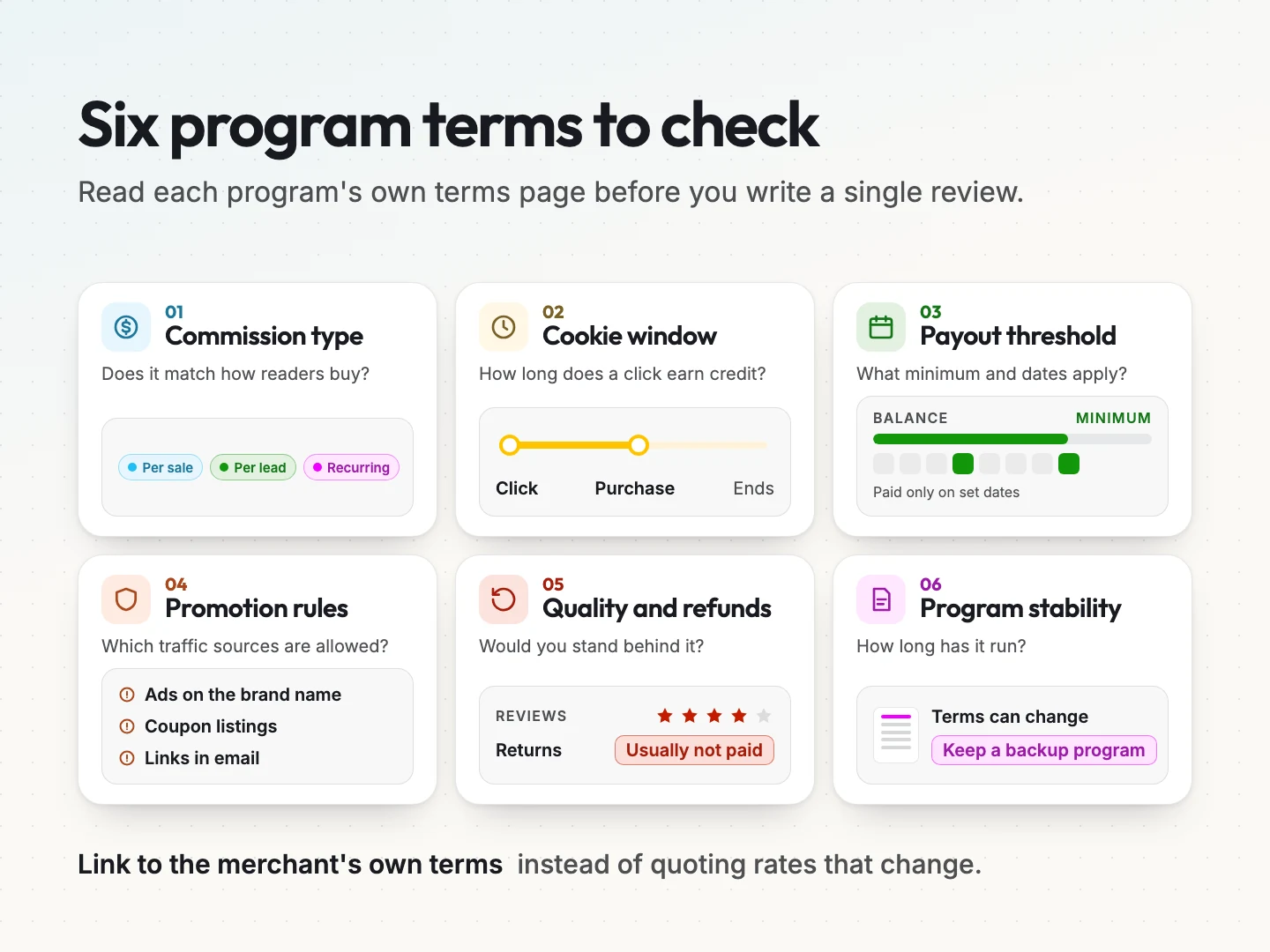
- **Commission type.** Is it per sale, per lead or recurring? Does it match how your readers buy?
- **Cookie window.** This is how long after a click a purchase still earns you credit. A short window suits impulse buys. A longer one suits products people research for weeks.
- **Payout threshold and schedule.** Many programs pay only after you reach a minimum balance, and only on set dates. Note both so you know when money could arrive.
- **Traffic and promotion rules.** Some programs ban paid ads on their brand name, coupon listings or links in email. Breaking a rule can cost you every commission earned.
- **Product quality and refunds.** Read customer reviews and the refund policy. Returned orders usually aren’t paid out, and a poor product hurts your reputation.
- **Program stability and terms changes.** Check how long the program has run and whether it can change terms at any time. Most can.
The Amazon Associates [Operating Agreement](https://affiliate-program.amazon.com/help/operating/agreement) is a useful example to read in full. It requires members to display a specific disclosure sentence, and it says Amazon may modify the terms at any time. Most programs reserve similar rights, which is why depending on one program is risky.
### Finding programs in your niche.
Start with the products you already use and trust. Many merchants link to their affiliate or partner program in the website footer. Affiliate networks list many programs you can search by category. You can also email a vendor you like and ask whether they run a program. A brand that knows your work may offer better terms than its public page shows.
### Avoid quoting rates as fact.
Avoid copying commission rates from roundup posts. Rates shift, and an outdated number on your page misleads readers. Link to the merchant’s own terms when you need to mention them.
## Disclose affiliate links the way the FTC expects.
If you earn money from a link, your readers need to know. In the United States, the Federal Trade Commission (FTC) sets the rules for endorsements, including affiliate links. Its [Endorsement Guides FAQ](https://www.ftc.gov/business-guidance/resources/ftcs-endorsement-guides-what-people-are-asking) answers the common questions in plain language.
Here is what that page says about affiliate links.
- **Make it clear and conspicuous.** Readers need to see the disclosure and the link together.
- **Place it close to the recommendation.** The FAQ says the closer the disclosure sits to your recommendation, the better. A note at the top of a long post can be overlooked, and one at the bottom may never be read.
- **A homepage note or disclosure button isn’t enough.** A single disclosure on your homepage doesn’t cover links elsewhere. Buttons labeled “disclosure” or “legal” are too easy to skip.
- **“Affiliate link” alone isn’t enough.** The FAQ says many readers may not understand what that label means. “Commissionable link” is probably unclear too. “Paid link” can work when it sits right next to the link.
- **Video and social need it too.** Disclose in the video itself and near the links in the description. A disclosure buried in the comments doesn’t count.
The FAQ offers a plain example: “I get commissions for purchases made through links in this post.” Place a sentence like that near the first affiliate link. Repeat it near later ones. That is far clearer than a note at the bottom of the page.
Programs can add their own rules. The Amazon agreement, for example, requires its own disclosure sentence on your site. Follow both the FTC guidance and each program’s terms.
This section is general information based on the FTC’s published guidance. It is not legal advice. If your situation is complex or you’re unsure, ask a qualified lawyer.
## Run a 60-day niche test before you commit.
Scoring tells you a niche looks promising. A test tells you whether readers agree. Before you plan a large site, publish a small batch of content and watch what happens for 60 days.
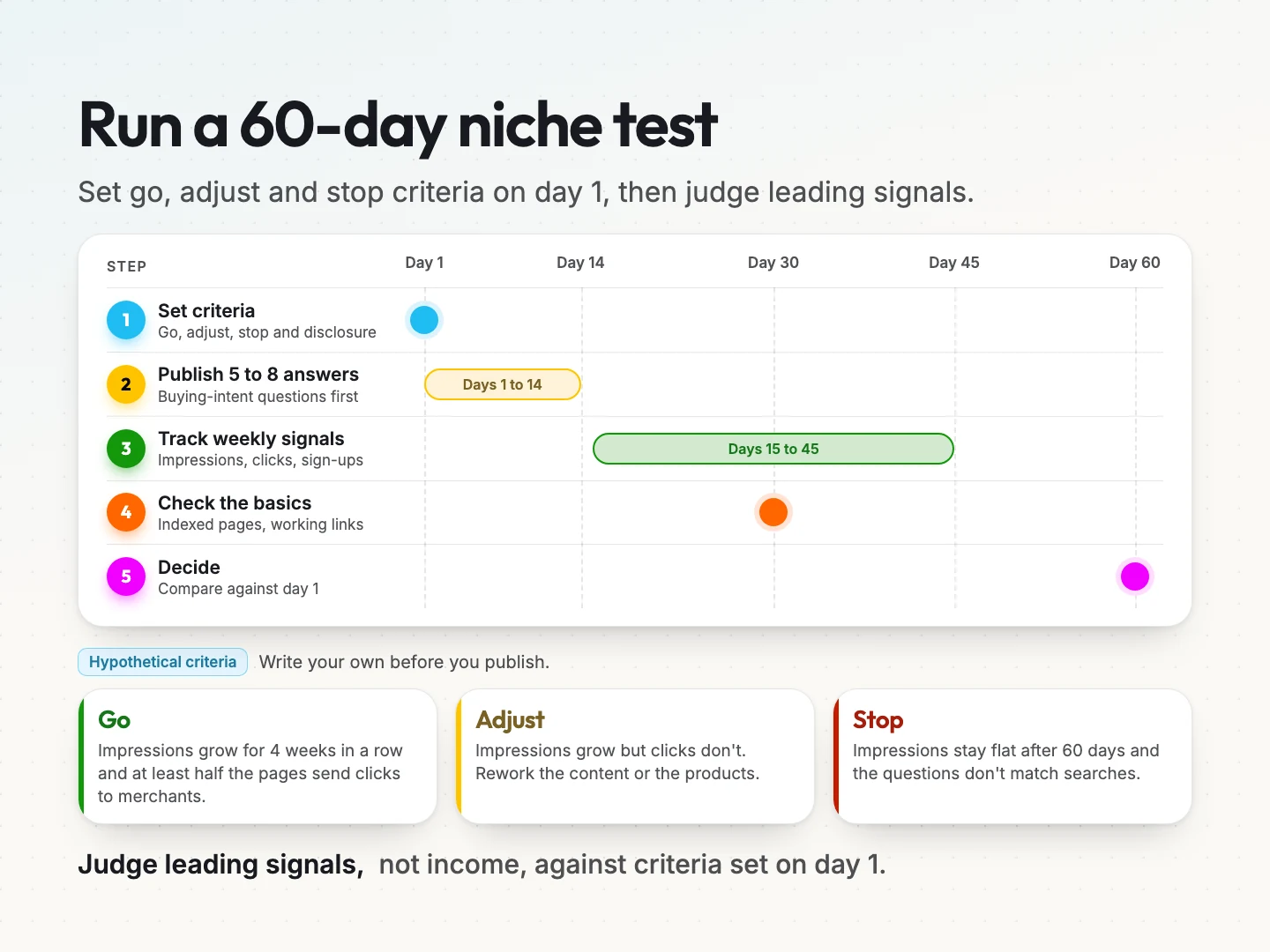
1. **Day 1: set your criteria.** Write down what “go”, “adjust” and “stop” mean before you publish anything. Deciding later invites wishful thinking. Add your disclosure wording now, because real affiliate links go live with the first page.
2. **Days 1 to 14: publish 5 to 8 answers.** Choose questions from your list that show buying intent. Write each one better than what currently ranks, with your own experience and honest tradeoffs.
3. **Days 15 to 45: track leading signals.** Check Search Console impressions, clicks to merchants and email sign-ups every week. These signals move long before income does.
4. **Day 30: check the basics.** Are the pages indexed? Are links tracking? Are readers asking follow-up questions? Fix technical problems now, not at the end.
5. **Day 60: decide.** Compare results against your day 1 criteria and choose go, adjust or stop.
### The first pages to publish.
Not every page type suits a test. Start with the content closest to a buying decision, because it shows whether readers will act on your advice.
- **How to choose guides.** “How to choose bookkeeping software as a freelance photographer” helps a reader narrow options.
- **Honest comparisons.** Two or three products side by side, with who each one suits and who it doesn’t.
- **Problem fixes.** A specific problem your audience hits, with the tool that solves it named only when it fits.
Skip broad “ultimate guides” during the test. They take longest to write and rarely show buying intent early.
### Setting your own criteria.
Here is a hypothetical set of criteria to adapt. Go if impressions grow for 4 weeks in a row and readers click to merchants from at least half the pages. Adjust if impressions grow but clicks don’t, which usually means the content or the products need work. Stop if impressions stay flat after 60 days and the questions you found don’t match what people search.
### Reading the results.
Judge the test on leading signals, not on income. Sixty days is often too short for search traffic to settle, so a slow start doesn’t automatically mean a bad niche. A flat line on every signal, though, is worth taking seriously.
If the niche passes, your next job is content that keeps working as products change. Our guide to [creating evergreen content](https://scayverstaging.1wp.site/blog/creating-evergreen-content/) covers how to build pages that stay accurate and useful long after you publish them.
## Automation on a niche affiliate site, and its limits.
Automation saves real time on a small affiliate site, but it can’t replace judgment. Use it for the repetitive work and keep a person on every recommendation.
These tasks are good candidates for automation.
- **Content workflow.** Turning your question list into briefs, outlines and first drafts that a person then edits. An [AI content workflow](https://scayverstaging.1wp.site/services/optimization/ai-content-workflow-automation/) can also flag pages that haven’t been reviewed in months.
- **Link checks.** Scheduled checks that find broken or redirected affiliate links before readers do.
- **Tracking.** Pulling Search Console data and merchant clicks into one view. A simple [analytics dashboard](https://scayverstaging.1wp.site/services/optimization/analytics-dashboards/) shows your 60-day signals without exporting spreadsheets.
These tasks need a person every time.
- **Choosing products.** Only recommend what you would stand behind without a commission.
- **Checking facts.** Prices, features and specs change. AI tools can state old details with confidence.
- **Approving disclosures.** Confirm the wording and placement on every page with affiliate links.
Google’s [spam policies](https://developers.google.com/search/docs/essentials/spam-policies) are clear on this point. They describe thin affiliation as pages that reuse merchant descriptions without adding value. They also say good affiliate sites add value with meaningful content or features. Mass-produced pages that add nothing new fit that description closely.
Search visibility also depends on structure and technical basics. For help with that side, see our [search engine optimization](https://scayverstaging.1wp.site/services/optimization/search-engine-optimization/) service. Teams that want help planning and producing articles can look at [content marketing](https://scayverstaging.1wp.site/services/marketing/content-marketing/).
## Final thoughts on choosing an affiliate niche.
The best affiliate niche for you is the one where demand, buying intent, solid programs, beatable competition and your own expertise all line up. A popular list can’t find that spot for you. A simple scorecard and an honest 60-day test can.
Start small. Score two or three ideas, check demand with free tools and read every program’s terms. Disclose your links clearly from the first page, and judge the test on signals you set on day 1.
If you’d like help planning the topics, content and tracking behind a niche site, [talk to a specialist](https://scayverstaging.1wp.site/talk-to-a-specialist/) about a content strategy for your niche.
Was this article helpful?
Same category
## The rest of Digital Marketing.
-
### [Why Your Marketing Numbers Don't Match, and How to Fix It.](https://scayverstaging.1wp.site/blog/marketing-data-discrepancies/)
Learn why analytics numbers don't match, how one spreadsheet join turns $100 of ad spend into $180, and how to report what is missing.
23 November 2026.
-
### [Podcast Episode Planning Before You Book a Guest.](https://scayverstaging.1wp.site/blog/podcast-episode-planning/)
Podcast episode planning starts before you book a guest. Set the listener decision, pick an angle and write six prompts with a brief you can copy.
20 November 2026.
-
### [Lead Magnet Delivery Email and Follow-Up Sequence.](https://scayverstaging.1wp.site/blog/lead-magnet-delivery-email/)
Write a lead magnet delivery email that gets the file used, then add five optional follow-ups with clear rules for who gets each one.
17 November 2026.
-
### [Social Media Approval Workflow for Small Teams.](https://scayverstaging.1wp.site/blog/social-media-approval-workflow/)
Build a social media approval workflow that signs off copy, image, account and time together, with a recovery rule for failed scheduled posts.
16 November 2026.
-
### [How to Launch an Online Community: Your First 30 Days.](https://scayverstaging.1wp.site/blog/launch-an-online-community/)
Learn how to launch an online community with one first contribution, a staff reply budget, a welcome post and a 30-day prompt queue.
11 November 2026.
-
### [How to Answer on Reddit and Quora Without Self-Promotion.](https://scayverstaging.1wp.site/blog/reddit-quora-marketing/)
Reddit marketing for small business works when you answer the real question, follow the rules, disclose your affiliation and pass the link test.
10 November 2026.
-
### [UTM Naming Convention: Track Campaign Links Cleanly.](https://scayverstaging.1wp.site/blog/utm-naming-convention/)
Set a UTM naming convention your team can follow. Use seven rules, a spreadsheet link builder and a route check so campaign counts stay comparable.
6 November 2026.
-
### [Weekly Social Media Content Plan Your Team Can Finish.](https://scayverstaging.1wp.site/blog/weekly-social-media-plan/)
Build a weekly social media content plan from the hours your team truly has. Size the post count, write full copy and use the free plan sheet.
5 November 2026.
-
### [Trade Show Demo Script Your Booth Team Can Deliver.](https://scayverstaging.1wp.site/blog/trade-show-demo/)
Get a trade show demo script with full spoken words, seven visitor branches, fallbacks and follow-ups that never promise a meeting nobody booked.
4 November 2026.
-
### [How to Run a Small Marketing Experiment, Step by Step.](https://scayverstaging.1wp.site/blog/small-marketing-experiment/)
Run a small marketing experiment that answers a real decision. Set a budget cap, an end date and a stop rule, then fill in the free worksheet.
2 November 2026.
-
### [Sponsorship Report: Check Delivery Against the Deal.](https://scayverstaging.1wp.site/blog/sponsorship-report/)
A sponsorship report should prove each sponsor benefit was delivered. Use a six-line ledger to match evidence to the deal and fix shortfalls.
21 October 2026.
-
### [Co-Marketing Partnership Brief: Deliverables and Rights.](https://scayverstaging.1wp.site/blog/co-marketing-partnership/)
Plan a co-marketing partnership with a brief that names each deliverable, who accepts it, the rights for each use and who owns the leads.
19 October 2026.
-
### [Cancellation Flow: Match the Response to the Reason.](https://scayverstaging.1wp.site/blog/cancellation-flow/)
Build a cancellation flow that matches each churn reason to a remedy you can deliver. See six worked cases and copy the ledger template.
15 October 2026.
-
### [Creating Evergreen Content That Earns Year-Round.](https://scayverstaging.1wp.site/blog/creating-evergreen-content/)
Learn how to create evergreen content that keeps bringing leads and sales. Pick lasting topics, build each page to convert and refresh it on a schedule.
11 August 2025.
-
### [How Email Segmentation Improves Engagement.](https://scayverstaging.1wp.site/blog/email-segmentation/)
Email segmentation sends each group of subscribers the message that fits. Build your first three segments, set them up in your tool and measure clicks.
3 June 2025.
-
### [How to Improve Email Open Rates and Reach the Inbox.](https://scayverstaging.1wp.site/blog/improve-email-open-rates/)
Improve email open rates the honest way. Fix SPF, DKIM and DMARC, meet Gmail and Yahoo sender rules, and write subject lines people trust.
3 June 2025.
-
### [Personal Branding on Social Media for Business Owners.](https://scayverstaging.1wp.site/blog/personal-branding-on-social-media/)
Personal branding on social media for business owners. Set up a profile that backs your company brand, post on a steady rhythm and track the inquiries.
3 June 2024.
-
### [How to Write Blog Articles That Bring In Customers.](https://scayverstaging.1wp.site/blog/articles-that-bring-in-customers/)
Learn how to write blog articles that bring in customers. Seven steps from buyer question to inquiry, with safe AI use and simple tracking. Start today.
3 June 2024.
-
### [Integrated Marketing for Small Business: A Simple Plan.](https://scayverstaging.1wp.site/blog/integrated-marketing-for-small-business/)
Learn integrated marketing for small business. Give each channel one job, connect your CRM and email, and measure the whole path from click to reply.
3 June 2024.
-
### [Easy Affiliate Marketing for Automated Income.](https://scayverstaging.1wp.site/blog/easy-affiliate-marketing-for-automated-income/)
Covers picking a niche, judging which affiliate products actually pay, and building the site and product setup behind more automated affiliate income.
3 June 2024.
-
### [100 Actionable SEO Tips for Driving More Website Traffic.](https://scayverstaging.1wp.site/blog/100-actionable-seo-tips-for-driving-more-website-traffic/)
One hundred short, numbered SEO tips covering domain choice, keyword research, content quality, images, competitors, and making sure your site can be crawled.
3 June 2024.
-
### [Copywriting Basics and Terminology.](https://scayverstaging.1wp.site/blog/copywriting-basics-and-terminology/)
The vocabulary and the fundamentals: what copywriting is for, how to define a target market, and how to sharpen and edit your own copy.
2 June 2024.
Keep reading
## More articles.
The rest of the blog, newest first.
- [25 November 2026 Sales Discovery Call Questions Built on the Next Decision.](https://scayverstaging.1wp.site/blog/sales-discovery-call-questions/)
- [24 November 2026 Contact Form Testing Checklist: 11 Checks Before Launch.](https://scayverstaging.1wp.site/blog/contact-form-testing-checklist/)
- [23 November 2026 Why Your Marketing Numbers Don't Match, and How to Fix It.](https://scayverstaging.1wp.site/blog/marketing-data-discrepancies/)
- [20 November 2026 Podcast Episode Planning Before You Book a Guest.](https://scayverstaging.1wp.site/blog/podcast-episode-planning/)
- [19 November 2026 Loyalty Program Rules Customers Can Actually Follow.](https://scayverstaging.1wp.site/blog/loyalty-program-rules/)
- [18 November 2026 Sales Pipeline Stages: Define When a Deal Moves.](https://scayverstaging.1wp.site/blog/sales-pipeline-stages/)
- [17 November 2026 Lead Magnet Delivery Email and Follow-Up Sequence.](https://scayverstaging.1wp.site/blog/lead-magnet-delivery-email/)
- [16 November 2026 Social Media Approval Workflow for Small Teams.](https://scayverstaging.1wp.site/blog/social-media-approval-workflow/)
- [13 November 2026 TAM SAM SOM for Small Businesses: Size a Real Market.](https://scayverstaging.1wp.site/blog/tam-sam-som/)
- [12 November 2026 How to Brief a Website Editor on a Page Change.](https://scayverstaging.1wp.site/blog/brief-a-website-editor/)
- [11 November 2026 How to Launch an Online Community: Your First 30 Days.](https://scayverstaging.1wp.site/blog/launch-an-online-community/)
- [10 November 2026 How to Answer on Reddit and Quora Without Self-Promotion.](https://scayverstaging.1wp.site/blog/reddit-quora-marketing/)
- [9 November 2026 Marketing Campaign Brief Template for Small Teams.](https://scayverstaging.1wp.site/blog/campaign-brief-template/)
- [6 November 2026 UTM Naming Convention: Track Campaign Links Cleanly.](https://scayverstaging.1wp.site/blog/utm-naming-convention/)
- [5 November 2026 Weekly Social Media Content Plan Your Team Can Finish.](https://scayverstaging.1wp.site/blog/weekly-social-media-plan/)
- [4 November 2026 Trade Show Demo Script Your Booth Team Can Deliver.](https://scayverstaging.1wp.site/blog/trade-show-demo/)
- [3 November 2026 Customer Segmentation That Changes What You Do Next.](https://scayverstaging.1wp.site/blog/customer-segmentation/)
- [2 November 2026 How to Run a Small Marketing Experiment, Step by Step.](https://scayverstaging.1wp.site/blog/small-marketing-experiment/)
- [30 October 2026 How to Analyze Customer Feedback From Mixed Sources.](https://scayverstaging.1wp.site/blog/customer-feedback-analysis/)
- [29 October 2026 Automation Permissions: What to Approve Before You Connect.](https://scayverstaging.1wp.site/blog/automation-permissions/)
- [28 October 2026 Choose an Automation Platform: Who Fixes It When It Fails?](https://scayverstaging.1wp.site/blog/choose-an-automation-platform/)
- [27 October 2026 What Should a Web Form Change in Your CRM?](https://scayverstaging.1wp.site/blog/web-form-crm-update-rules/)
- [26 October 2026 Integration Requirements to Write Before Connecting Apps.](https://scayverstaging.1wp.site/blog/integration-requirements/)
- [23 October 2026 WordPress Plugin or Custom Build? Define the Process First.](https://scayverstaging.1wp.site/blog/plugin-or-custom-development/)
- [22 October 2026 AI Marketing Workflow vs Manual Work: A Fair Test.](https://scayverstaging.1wp.site/blog/ai-marketing-workflow-vs-manual/)
- [21 October 2026 Sponsorship Report: Check Delivery Against the Deal.](https://scayverstaging.1wp.site/blog/sponsorship-report/)
- [20 October 2026 How to Prioritize Marketing When Your Team Is Small.](https://scayverstaging.1wp.site/blog/prioritize-marketing-small-team/)
- [19 October 2026 Co-Marketing Partnership Brief: Deliverables and Rights.](https://scayverstaging.1wp.site/blog/co-marketing-partnership/)
- [16 October 2026 How to Do a Competitor Analysis You Can Keep Current.](https://scayverstaging.1wp.site/blog/competitor-analysis/)
- [15 October 2026 Cancellation Flow: Match the Response to the Reason.](https://scayverstaging.1wp.site/blog/cancellation-flow/)
- [6 October 2026 Why We Rebuilt the Scayver Graphix Website.](https://scayverstaging.1wp.site/blog/scayver-graphix-website-rebuild/)
- [3 October 2026 Five AI System Design Mistakes to Avoid.](https://scayverstaging.1wp.site/blog/ai-system-design-mistakes/)
- [3 October 2026 100 AI Terms Explained in Plain English.](https://scayverstaging.1wp.site/blog/ai-terms-explained/)
- [11 August 2025 Website Design That Increases Sales: 6 Page Fixes.](https://scayverstaging.1wp.site/blog/website-design-that-increases-sales/)
- [3 June 2025 How Email Segmentation Improves Engagement.](https://scayverstaging.1wp.site/blog/email-segmentation/)
- [3 June 2025 Best CRM for Customer Retention: 5 Tools Compared.](https://scayverstaging.1wp.site/blog/best-crm-for-customer-retention/)
- [3 June 2025 How to Improve Email Open Rates and Reach the Inbox.](https://scayverstaging.1wp.site/blog/improve-email-open-rates/)
- [16 August 2024 Professional Logo Design Process: Steps, Costs, Files.](https://scayverstaging.1wp.site/blog/professional-logo-design-process/)
- [3 June 2024 Personal Branding on Social Media for Business Owners.](https://scayverstaging.1wp.site/blog/personal-branding-on-social-media/)
- [3 June 2024 How to Build a Brand for a Small Business in 8 Steps.](https://scayverstaging.1wp.site/blog/how-to-build-a-brand/)
- [3 June 2024 How to Write Blog Articles That Bring In Customers.](https://scayverstaging.1wp.site/blog/articles-that-bring-in-customers/)
- [3 June 2024 Integrated Marketing for Small Business: A Simple Plan.](https://scayverstaging.1wp.site/blog/integrated-marketing-for-small-business/)
- [3 June 2024 100 Actionable SEO Tips for Driving More Website Traffic.](https://scayverstaging.1wp.site/blog/100-actionable-seo-tips-for-driving-more-website-traffic/)
- [2 June 2024 Copywriting Basics and Terminology.](https://scayverstaging.1wp.site/blog/copywriting-basics-and-terminology/)
FAQ
## Questions about niche affiliate marketing
The things people ask on the first call. If yours is not here, ask us directly.
[Ask us directly](https://scayverstaging.1wp.site/talk-to-a-specialist/?form=book)
**Can a local service business use affiliate marketing?**
Yes, when the products support the service you already sell. A landscaper might recommend tools for keeping a new lawn healthy, and an accountant might compare invoicing apps. Keep recommendations secondary to your own offer, and never recommend a product that competes with work you would rather do for the client yourself.
**How narrow is too narrow for an affiliate niche?**
A niche is too narrow when you can’t find about 20 real questions people ask, or when only one merchant sells what your readers need. If that happens, widen by one step, such as from one product type to the full problem it solves, while keeping the same audience.
**Do I need a website, or can I start on social media or email?**
You can start anywhere you already have an audience, as long as each program allows that channel. Some programs restrict links in email or on certain platforms, so check the terms first. A website you own gives you search traffic and a home that no platform can switch off, so most people add one later.
**Is Amazon Associates a good place to start?**
It is a common first program because it covers so many products, but read its Operating Agreement before relying on it. The agreement requires a set disclosure sentence on your site and lets Amazon change terms at any time. Pair it with direct programs from brands in your niche so one change can’t stop all income.
**Do affiliate links hurt my SEO?**
Not by themselves. Google’s link guidance asks you to mark paid links with rel=”sponsored” or rel=”nofollow”, and affiliate links are commonly treated that way. The bigger risk is thin content. Pages that only repeat merchant descriptions add no value, so write from your own testing and experience.