# Sponsorship Report: Check Delivery Against the Deal.
> A sponsorship report should prove each sponsor benefit was delivered. Use a six-line ledger to match evidence to the deal and fix shortfalls.
Source: https://scayverstaging.1wp.site/blog/sponsorship-report/
A practical guide for event and marketing teams that need to show sponsors what was promised, what was delivered and the proof behind each item.
Start reading [All articles](https://scayverstaging.1wp.site/blog/)
**Written by**
Scayver
**Published**
21 October 2026
**Reading time**
17 min
A sponsorship report shows a sponsor what you promised in the agreement, what was delivered and the proof behind each item. A good one lists every obligation, attaches evidence the sponsor can open, marks anything that fell short and says how you will make it right. That honesty is what makes renewal talks easier.
Most event recaps do the opposite. They open with a crowd photo, a big attendance number and a page of logos, then hope nobody asks about the second social post that never ran. Sponsors notice. Their marketing teams sit in budget meetings where someone asks what the money bought, and a glossy recap with no proof does not answer that question.
This guide builds the report around the deal itself. You will pull the obligations from the signed agreement and collect evidence while the event runs. Then you fill a six-line delivery ledger, sort each line by status and write a plain correction for anything that came up short. The worked example is hypothetical, so you can adapt it to your own event, venue or campaign.
## The proof a sponsorship report must carry.
A sponsorship report has one job. It proves that each benefit the sponsor paid for was delivered as agreed, or it says clearly where it was not. Everything else, including attendance, photos and thank-you notes, supports that job.
Every line of the report answers the same chain of questions. What did we promise? What happened? What evidence shows it? Did it meet the rule we agreed on?

If a line cannot answer all four, it is not finished. A photo of the sponsor’s logo on a banner answers the second question but not always the first. The agreement may have promised the logo on the main stage backdrop, at a set size, in the current brand version. A photo of a hallway banner does not prove that.
### Fulfillment report, recap or return on investment report.
People use these names loosely, so it helps to separate them. A sponsor fulfillment report checks delivery against the agreement, line by line. A sponsor recap tells the story of the event and shows highlights. A return on investment report estimates the value the sponsor got, often with figures the sponsor supplies from their own sales records.
This article focuses on fulfillment, because the other two rest on it. A recap without a fulfillment check reads like marketing. A value estimate built on deliverables that never ran is worse. Get the delivery record right first, and the story and the value estimate become far easier to trust.
### The reader on the sponsor side.
Your contact at the sponsor may love your event. Their manager, their finance team or their agency may never have been there. Write the report for the person who was not in the room. They need to find each benefit, see the proof and understand any gap without calling you.
That reader often decides whether the budget comes back next year, so give them a document they can forward without editing.
## Start from the signed deal, not the recap deck.
The most common mistake is building the report from memory. Teams list what they remember doing, which tends to be the things that went well. Start from the signed agreement or the final approved proposal instead. Copy every sponsor benefit into a list before the event begins.
If the agreement was revised during negotiation, use the version both sides signed or approved last. A proposal deck and a signed agreement often list different benefits. The signed version is the one the sponsor will check you against.
### Turn each benefit into a checkable obligation.
Agreement language is often vague. Phrases like “prominent logo placement” or “social media support” cannot be checked as written. Rewrite each benefit as an obligation that names five things.
1. **The item.** What the sponsor gets, such as a logo, a booth, a post or a speaking slot.
2. **The place or channel.** Where it appears, such as the main stage, the event app or a named social account.
3. **The quantity or duration.** How many, how big or how long.
4. **The version.** Which logo file, message or link the sponsor approved.
5. **The acceptance rule.** What counts as delivered, agreed in advance.
The acceptance rule is the part most teams skip. It settles how you will both know an item is done before anyone has a reason to argue. For a social post, the rule might be “published on our main account during the agreed week, tagging the sponsor, with their approved link.”
### Confirm the obligations with the sponsor before the event.
Send the list to your sponsor contact and ask them to confirm it in writing. It takes a few minutes and prevents most disputes. If they expected something you did not plan, you find out while you can still fix it. If a benefit changed during negotiation, the confirmed list records the change.
Keep the confirmed list with the agreement. When the report goes out, the sponsor checks it against a list they already approved. That makes the report feel like a closing step instead of a sales pitch.
If you plan the sponsor package itself with a partner, write deliverables and usage rights so both sides understand them the same way.
## Collect evidence while the event is running.
Evidence is hardest to find after the event. The backdrop gets torn down, the booth is packed and the social posts scroll out of sight. Plan who captures what before the doors open, and give each obligation an owner.

### Before the event.
Save the approved files and messages for every obligation. That means the logo version, the ad artwork, the email copy and any links with tracking parameters. Screenshot printed proofs and digital placements before they go live. If you produce [trade show banners](https://scayverstaging.1wp.site/services/design/trade-show-banners/) or signage that carry sponsor logos, keep the final proof and the print order with the sponsor’s folder.
### During the event.
Assign one person to a simple capture list. They photograph each physical placement with something in frame that shows where it is, such as the stage, the entrance or a room sign. They note the time of each photo. They screenshot live digital placements, such as the event app, the website sponsor page and any screen loops.
Photos should show placement in context. A close crop of a logo proves the logo exists. A wider shot that includes the stage and the room proves it was where the agreement said it would be.
### After the event.
Collect the records that only exist afterward. These include the email platform report for any sponsor mention, the social post links with their native analytics, the booth scan export and the session recording for any speaking slot. Pull them within a week, before platforms archive anything or staff move on to the next project.
Store everything in one folder per sponsor, with file names that match the obligation numbers. When you build the ledger, each line can then point to its evidence by name.
### Signs of good evidence.
Good evidence is specific, dated and checkable. A link the sponsor can open beats a screenshot. A screenshot with the date and address visible beats a cropped one. A platform report beats a number typed into a slide.
Be careful with numbers. Report what the platform shows, name the platform and the date you pulled it, and say what the number means. “Sent to 2,140 opted-in attendees, per the email platform report pulled the day after the send” is useful. “Huge email reach” is not. That figure is hypothetical, so swap in your own.
This is the same check a media buyer runs before paying for ads. Verify each paid placement against the agreed deliverable before approving payment. Your sponsor is running that check on you.
## Sponsorship deliverables that are hardest to prove.
Some benefits are easy to show. A booth is either there or it is not. Others leave little trace unless you plan for them. These are the ones that most often end up with weak evidence.
### Screen loops and digital signage.
A logo in a rotating screen loop may appear for a few seconds at a time. A single photo shows it once. Record a short video of one full loop, note the loop length and the hours the screens ran, and keep the loop file itself. That lets the sponsor see both the placement and how often it appeared.
### Verbal mentions and host acknowledgments.
A host thanking the sponsor from the stage is a real benefit, but it disappears the moment it is spoken. If the session is recorded, note the time stamp. If it is not, write the mention into the run sheet and have the stage manager initial it when it happens.
### Speaking slots.
The agreement usually names a length and a stage. Agendas slip, and a talk can lose minutes to a late start. Keep the recording or note the actual start and end times. If the slot ran short, that is a line for the correction section, not a detail to skip.
### Lead lists and booth scans.
A promised lead list is only delivered when the sponsor has it, in the agreed format, by the agreed date. It should contain only people who agreed to share their details. Record the send date, the file format and the number of records, and confirm the sponsor received it.
### Sampling, hospitality and printed materials.
Product samples, branded lanyards and printed programs are delivered in quantities. Keep the delivery note or count sheet, and photograph the items in use. If the sponsor supplied the items, record what arrived and what was handed out.
## Build the six-obligation delivery ledger.
The delivery ledger is the heart of the report. It is a simple table with one row per obligation. Each row records the promise, what was delivered, the evidence and a status. You can build it in a spreadsheet, a shared document or your project tool.
### The ledger template.
Copy these columns into your own sheet. The template works for any number of obligations, and the worked example below uses six.
| Column | What to write |
| --- | --- |
| Number | The obligation number from the confirmed list |
| Promise | The obligation in the agreement’s words |
| Acceptance rule | What both sides agreed counts as delivered |
| Delivered | What happened, in plain terms |
| Evidence | File names or links the sponsor can open |
| Status | Delivered, variance, short or missing |
| Owner | The person who answers questions on this line |
| Action | The correction or next step, if any |
Keep each cell short. The sponsor should be able to read a row in a few seconds and open the evidence when they want more detail.
### A worked example with six obligations.
Here is a hypothetical ledger for a gold sponsor at a one-day regional trade show. The sponsor, the show and every number in it are invented to show the method.

| Number | Promise | Delivered | Evidence | Status |
| --- | --- | --- | --- | --- |
| 1 | Logo on the main stage backdrop, current version | Backdrop printed with the previous logo version | Photo 01, print proof | Variance |
| 2 | 10 by 10 foot booth at the hall entrance | Booth at the hall entrance, as agreed | Floor plan, photo 02 | Delivered |
| 3 | Two dedicated posts on the main social account | One post published, one never scheduled | Post link 03 | Short |
| 4 | Logo and link in the attendee welcome email | Sent to 2,140 opted-in attendees | Email report 04 | Delivered |
| 5 | 20 minute speaking slot on the main stage | Slot started late and ran 12 minutes | Recording 05, agenda | Short |
| 6 | Opted-in booth scan list within 7 days | Export not yet sent | None yet | Missing |
Two lines were delivered cleanly. One was delivered with a variance. Two came up short and one is still missing. That is a realistic mix, and it is far more useful to the sponsor than a slide that says every benefit was delivered.
### Fill the owner and action columns.
The table above leaves out two columns to stay readable. In your own ledger, every line with a status other than delivered needs an owner and an action. For line 6, that might read “Events coordinator. Send the export by Friday and confirm receipt.” A line without an owner tends to stay unresolved.
### Reuse the ledger for every sponsor.
Once you have built one ledger, keep the blank version. Each new sponsor gets a copy, filled from their confirmed obligation list before the event. By the time the event ends, the promise and acceptance columns are already done. Your team only fills in delivery, evidence and status.
## Read each line as delivered, variance, short or missing.
A status word does a lot of work in a sponsorship report. Agree on what each one means and use them the same way every time. These four cover almost every case.
### Delivered.
The item ran as promised and meets the acceptance rule. The evidence shows it, and the sponsor can open that evidence. No action is needed beyond filing the proof.
### Variance.
The item ran, but something differs from the promise. The logo version, the size, the position or the timing changed. A variance is not always a failure. A booth moved to a busier spot is a change the sponsor may welcome. You still name it, because the sponsor should hear about changes from you first.
### Short.
The item ran, but less of it than promised. One post instead of two. A 12 minute talk instead of 20 minutes. A banner that was up for half the event. Short lines need a correction, even when the shortfall seems small to you.
### Missing.
The item did not happen, or you have no evidence that it did. Treat missing evidence the same as a missing item until you find the proof. It is tempting to mark something delivered because you are sure it ran. If you cannot show it, the sponsor cannot check it.
### Hold a line when evidence is still coming.
Some evidence arrives late, such as a platform report or a lead export. Mark these lines as missing with a clear date for the evidence, rather than leaving them blank. A blank cell reads like you forgot. A dated note reads like you are handling it.
## Write an honest correction when you fell short.
A shortfall does not have to cost you the sponsor. Hiding one often does. Most sponsors know events rarely go exactly to plan. What they remember is whether you told them first and whether you made it right.
### The four parts of a good correction.
1. **Name the gap.** State the obligation, what was promised and what happened, in one or two sentences.
2. **Explain briefly.** Give the reason without excuses or blame. One sentence is usually enough.
3. **Offer a make-good.** Propose something of similar value that you can deliver, with a date.
4. **Ask for confirmation.** Let the sponsor accept the offer or suggest another.
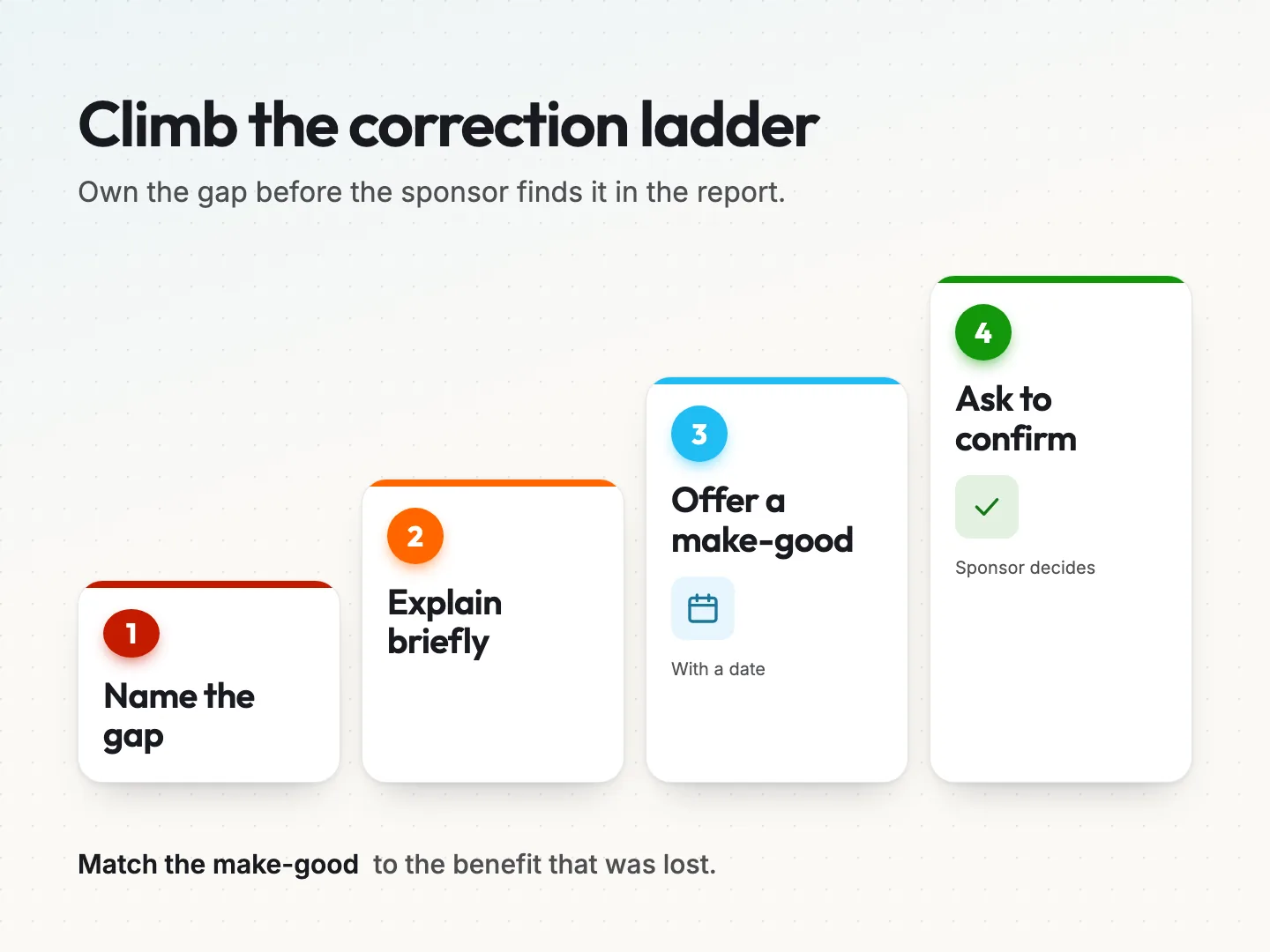
A make-good should match the lost benefit. If a social post did not run, the natural fix is a post of the same type, perhaps with a small extra. If the logo version was wrong on a printed backdrop, a reprint is not possible after the event. Offer extra digital placement or a credit toward the next event instead.
### A correction message you can adapt.
Here is a hypothetical message for line 3 in the example ledger.
> Hi Jordan, thank you again for sponsoring the show. Your agreement included two dedicated posts on our main social account. One ran on the event day, and the second was never scheduled. That was our mistake. We would like to publish it next Tuesday with your approved copy and link. Does that date work for you?
It is short, specific and owned. It does not bury the gap under praise for the event. It does not ask the sponsor to do extra work. It offers a fix with a date and leaves the decision with them.
### The right time to send a correction.
Send corrections before the full report, or at the latest alongside it. A sponsor who finds a shortfall you did not flag will reread every other line with doubt. A sponsor who already heard about it from you reads the report as confirmation.
If a shortfall happened in public, such as a wrong logo on a livestream, consider whether the affected audience needs a correction.
## Turn the ledger into the report the sponsor reads.
The ledger is your working record. The report is what the sponsor reads. It should be short enough to read in one sitting and complete enough that nobody needs to ask for more.
### A simple report structure.
1. **Summary.** Two or three sentences on the event, with an honest count, such as two of six obligations delivered exactly as promised.
2. **The ledger.** The full table, with links to each piece of evidence.
3. **Corrections.** Each short or missing line, the make-good offered and its current status.
4. **Highlights.** A few photos and figures that show the sponsor’s presence, each tied to an obligation number.
5. **Audience facts.** Attendance and audience details you can support, with the counting method named.
6. **Next steps.** Dates for any pending evidence and an invitation to talk about next year.
Putting corrections before highlights may feel uncomfortable. It is also what makes the highlights believable.
### Keep the numbers honest.
Report attendance the way you counted it, such as badge scans, tickets sold or a door count, and say which one you used. Do not blend registrations with attendees. If you estimate impressions, show the method or leave the estimate out. Sponsors compare reports across events, and inflated numbers are easy to spot.
### Send it on a promised date.
Tell the sponsor when the report will arrive, ideally when you confirm the obligation list. Allow enough time for platform reports and lead exports, then send it on that date even if one line is still pending. A dated pending note is better than a late report.
### Follow up with attendees too.
The sponsor’s value often depends on what happens after the event. If your agreement includes emails after the event, match them to what attendees asked about. Our guide to [email segmentation](https://scayverstaging.1wp.site/blog/email-segmentation/) covers how to do that without wearing out the list.
## Mistakes that make sponsors doubt the report.
A few habits undo the work of a careful ledger. Watch for these before you send anything.
- **Leading with the crowd shot.** Open with the delivery summary. The crowd shot can come later as a highlight.
- **Blending recap and fulfillment.** Keep the line-by-line check separate from the story, so the sponsor can find it.
- **Using evidence that proves the wrong thing.** A logo close-up does not prove placement, size or duration.
- **Reporting vanity numbers.** Total social followers say nothing about the sponsor’s posts. Report the posts themselves.
- **Saying nothing about a shortfall.** The sponsor will likely find it, and the silence costs more than the gap.
- **Sending it late.** A report that arrives after renewal talks begin looks like a sales document.
### Run a quick check before you send.
Before the report goes out, ask someone who did not work the event to read it. Have them pick any row and open the evidence. If they cannot match the evidence to the promise in about a minute, fix that row. If they ask a question the report does not answer, add the answer.
## Final thoughts.
A sponsorship report is not a thank-you card. It is a record that shows the sponsor exactly what their money bought and what you are doing about anything that fell short. Building it from the signed deal, capturing evidence as you go and owning the gaps tends to make the renewal conversation much simpler.
Start with the next sponsor on your calendar. Copy their benefits into the delivery ledger, confirm the list with them and give one person the capture list. If you want support on the event side, from sponsor placements to signage and follow-up, our [event management](https://scayverstaging.1wp.site/services/development/event-management/) team can plan it with you.
If you would rather review your current sponsor package first, [talk to a specialist](https://scayverstaging.1wp.site/talk-to-a-specialist/) and bring the agreement with you.
Was this article helpful?
Same category
## The rest of Digital Marketing.
-
### [Trade Show Demo Script Your Booth Team Can Deliver.](https://scayverstaging.1wp.site/blog/trade-show-demo/)
Get a trade show demo script with full spoken words, seven visitor branches, fallbacks and follow-ups that never promise a meeting nobody booked.
4 November 2026.
-
### [How to Run a Small Marketing Experiment, Step by Step.](https://scayverstaging.1wp.site/blog/small-marketing-experiment/)
Run a small marketing experiment that answers a real decision. Set a budget cap, an end date and a stop rule, then fill in the free worksheet.
2 November 2026.
-
### [Co-Marketing Partnership Brief: Deliverables and Rights.](https://scayverstaging.1wp.site/blog/co-marketing-partnership/)
Plan a co-marketing partnership with a brief that names each deliverable, who accepts it, the rights for each use and who owns the leads.
19 October 2026.
-
### [Cancellation Flow: Match the Response to the Reason.](https://scayverstaging.1wp.site/blog/cancellation-flow/)
Build a cancellation flow that matches each churn reason to a remedy you can deliver. See six worked cases and copy the ledger template.
15 October 2026.
-
### [Creating Evergreen Content That Earns Year-Round.](https://scayverstaging.1wp.site/blog/creating-evergreen-content/)
Learn how to create evergreen content that keeps bringing leads and sales. Pick lasting topics, build each page to convert and refresh it on a schedule.
11 August 2025.
-
### [Niche Affiliate Marketing: How to Choose Your Niche.](https://scayverstaging.1wp.site/blog/niche-affiliate-marketing/)
Niche affiliate marketing starts with the right niche. Score yours on five tests, vet the programs and disclose links properly before you build.
30 July 2025.
-
### [How Email Segmentation Improves Engagement.](https://scayverstaging.1wp.site/blog/email-segmentation/)
Email segmentation sends each group of subscribers the message that fits. Build your first three segments, set them up in your tool and measure clicks.
3 June 2025.
-
### [How to Improve Email Open Rates and Reach the Inbox.](https://scayverstaging.1wp.site/blog/improve-email-open-rates/)
Improve email open rates the honest way. Fix SPF, DKIM and DMARC, meet Gmail and Yahoo sender rules, and write subject lines people trust.
3 June 2025.
-
### [Personal Branding on Social Media for Business Owners.](https://scayverstaging.1wp.site/blog/personal-branding-on-social-media/)
Personal branding on social media for business owners. Set up a profile that backs your company brand, post on a steady rhythm and track the inquiries.
3 June 2024.
-
### [How to Write Blog Articles That Bring In Customers.](https://scayverstaging.1wp.site/blog/articles-that-bring-in-customers/)
Learn how to write blog articles that bring in customers. Seven steps from buyer question to inquiry, with safe AI use and simple tracking. Start today.
3 June 2024.
-
### [Integrated Marketing for Small Business: A Simple Plan.](https://scayverstaging.1wp.site/blog/integrated-marketing-for-small-business/)
Learn integrated marketing for small business. Give each channel one job, connect your CRM and email, and measure the whole path from click to reply.
3 June 2024.
-
### [Easy Affiliate Marketing for Automated Income.](https://scayverstaging.1wp.site/blog/easy-affiliate-marketing-for-automated-income/)
Covers picking a niche, judging which affiliate products actually pay, and building the site and product setup behind more automated affiliate income.
3 June 2024.
-
### [100 Actionable SEO Tips for Driving More Website Traffic.](https://scayverstaging.1wp.site/blog/100-actionable-seo-tips-for-driving-more-website-traffic/)
One hundred short, numbered SEO tips covering domain choice, keyword research, content quality, images, competitors, and making sure your site can be crawled.
3 June 2024.
-
### [Copywriting Basics and Terminology.](https://scayverstaging.1wp.site/blog/copywriting-basics-and-terminology/)
The vocabulary and the fundamentals: what copywriting is for, how to define a target market, and how to sharpen and edit your own copy.
2 June 2024.
Keep reading
## More articles.
The rest of the blog, newest first.
- [4 November 2026 Trade Show Demo Script Your Booth Team Can Deliver.](https://scayverstaging.1wp.site/blog/trade-show-demo/)
- [3 November 2026 Customer Segmentation That Changes What You Do Next.](https://scayverstaging.1wp.site/blog/customer-segmentation/)
- [2 November 2026 How to Run a Small Marketing Experiment, Step by Step.](https://scayverstaging.1wp.site/blog/small-marketing-experiment/)
- [30 October 2026 How to Analyze Customer Feedback From Mixed Sources.](https://scayverstaging.1wp.site/blog/customer-feedback-analysis/)
- [29 October 2026 Automation Permissions: What to Approve Before You Connect.](https://scayverstaging.1wp.site/blog/automation-permissions/)
- [28 October 2026 Choose an Automation Platform: Who Fixes It When It Fails?](https://scayverstaging.1wp.site/blog/choose-an-automation-platform/)
- [27 October 2026 What Should a Web Form Change in Your CRM?](https://scayverstaging.1wp.site/blog/web-form-crm-update-rules/)
- [26 October 2026 Integration Requirements to Write Before Connecting Apps.](https://scayverstaging.1wp.site/blog/integration-requirements/)
- [23 October 2026 WordPress Plugin or Custom Build? Define the Process First.](https://scayverstaging.1wp.site/blog/plugin-or-custom-development/)
- [22 October 2026 AI Marketing Workflow vs Manual Work: A Fair Test.](https://scayverstaging.1wp.site/blog/ai-marketing-workflow-vs-manual/)
- [20 October 2026 How to Prioritize Marketing When Your Team Is Small.](https://scayverstaging.1wp.site/blog/prioritize-marketing-small-team/)
- [19 October 2026 Co-Marketing Partnership Brief: Deliverables and Rights.](https://scayverstaging.1wp.site/blog/co-marketing-partnership/)
- [16 October 2026 How to Do a Competitor Analysis You Can Keep Current.](https://scayverstaging.1wp.site/blog/competitor-analysis/)
- [15 October 2026 Cancellation Flow: Match the Response to the Reason.](https://scayverstaging.1wp.site/blog/cancellation-flow/)
- [6 October 2026 Why We Rebuilt the Scayver Graphix Website.](https://scayverstaging.1wp.site/blog/scayver-graphix-website-rebuild/)
- [3 October 2026 Five AI System Design Mistakes to Avoid.](https://scayverstaging.1wp.site/blog/ai-system-design-mistakes/)
- [3 October 2026 100 AI Terms Explained in Plain English.](https://scayverstaging.1wp.site/blog/ai-terms-explained/)
- [11 August 2025 Website Design That Increases Sales: 6 Page Fixes.](https://scayverstaging.1wp.site/blog/website-design-that-increases-sales/)
- [3 June 2025 How Email Segmentation Improves Engagement.](https://scayverstaging.1wp.site/blog/email-segmentation/)
- [3 June 2025 Best CRM for Customer Retention: 5 Tools Compared.](https://scayverstaging.1wp.site/blog/best-crm-for-customer-retention/)
- [3 June 2025 How to Improve Email Open Rates and Reach the Inbox.](https://scayverstaging.1wp.site/blog/improve-email-open-rates/)
- [16 August 2024 Professional Logo Design Process: Steps, Costs, Files.](https://scayverstaging.1wp.site/blog/professional-logo-design-process/)
- [3 June 2024 Personal Branding on Social Media for Business Owners.](https://scayverstaging.1wp.site/blog/personal-branding-on-social-media/)
- [3 June 2024 How to Build a Brand for a Small Business in 8 Steps.](https://scayverstaging.1wp.site/blog/how-to-build-a-brand/)
- [3 June 2024 How to Write Blog Articles That Bring In Customers.](https://scayverstaging.1wp.site/blog/articles-that-bring-in-customers/)
- [3 June 2024 Integrated Marketing for Small Business: A Simple Plan.](https://scayverstaging.1wp.site/blog/integrated-marketing-for-small-business/)
- [3 June 2024 100 Actionable SEO Tips for Driving More Website Traffic.](https://scayverstaging.1wp.site/blog/100-actionable-seo-tips-for-driving-more-website-traffic/)
- [2 June 2024 Copywriting Basics and Terminology.](https://scayverstaging.1wp.site/blog/copywriting-basics-and-terminology/)
FAQ
## Questions about sponsorship reports
The things people ask on the first call. If yours is not here, ask us directly.
[Ask us directly](https://scayverstaging.1wp.site/talk-to-a-specialist/?form=book)
**Should a sponsorship report include return on investment for the sponsor?**
Only when you can support it. You usually know delivery and audience facts, while the sponsor knows their own sales and leads. Share your verified numbers and ask the sponsor what they measured. A joint value estimate built on both sets of data is more credible than a figure you calculate alone.
**Do small community events need a formal sponsorship report?**
Yes, though it can be short. A one-page ledger with each benefit, a photo or link as proof and a status is enough for a local sponsor. Small sponsors often renew based on trust, and a simple honest record shows them you track what they paid for.
**What if the sponsor caused the shortfall, such as sending artwork late?**
Record it plainly on the line, with dates. Note when the artwork was due, when it arrived and what that changed. Keep the tone factual rather than defensive. You can still offer a goodwill make-good, but the record shows the gap did not come from your side.
**Can I share attendee details in a sponsorship report?**
Share personal details only with people who agreed to it, such as attendees who opted in at the sponsor’s booth. For everyone else, report totals and audience groups rather than names. Check your registration terms and local privacy rules, and ask a qualified adviser if you are unsure.
**How do I report on sponsorships for online or hybrid events?**
Use the same ledger, with digital evidence. Screenshots of sponsor slides in the stream, session recordings with time stamps, platform reports for booth visits and chat mentions all work. Name the platform and the date you pulled each report, since online platforms often count views and visits differently.