


To build a brand, decide who you serve and why they should pick you over the alternatives, then make a promise you can keep. Express it through a name, a visual identity and a voice. Write it down in short guidelines, apply it everywhere customers meet you, and check whether people remember it.
That is the whole job in one paragraph. The rest of this guide walks through it in eight steps, in the order the decisions depend on each other. You will find a positioning exercise you can do on paper, a one-page guidelines outline and four simple checks that show whether your brand is working.
What building a brand actually means.
A brand is what people expect from your business before they deal with you. It lives in their heads, built from every website visit, phone call, invoice and review. A logo is only the mark that reminds them of that expectation.
Three words get mixed up often, so here they are in plain terms.
- Brand. The expectation people hold about you: what you do, who you do it for and what it feels like to work with you.
- Brand identity. The visible and audible parts you control, such as your name, logo, colors, type, images and voice.
- Logo. One piece of the identity. It is a signature, not the whole letter.
So building a brand starts with decisions about that expectation. Only then do you design how it looks and sounds, and repeat it every time someone meets you.
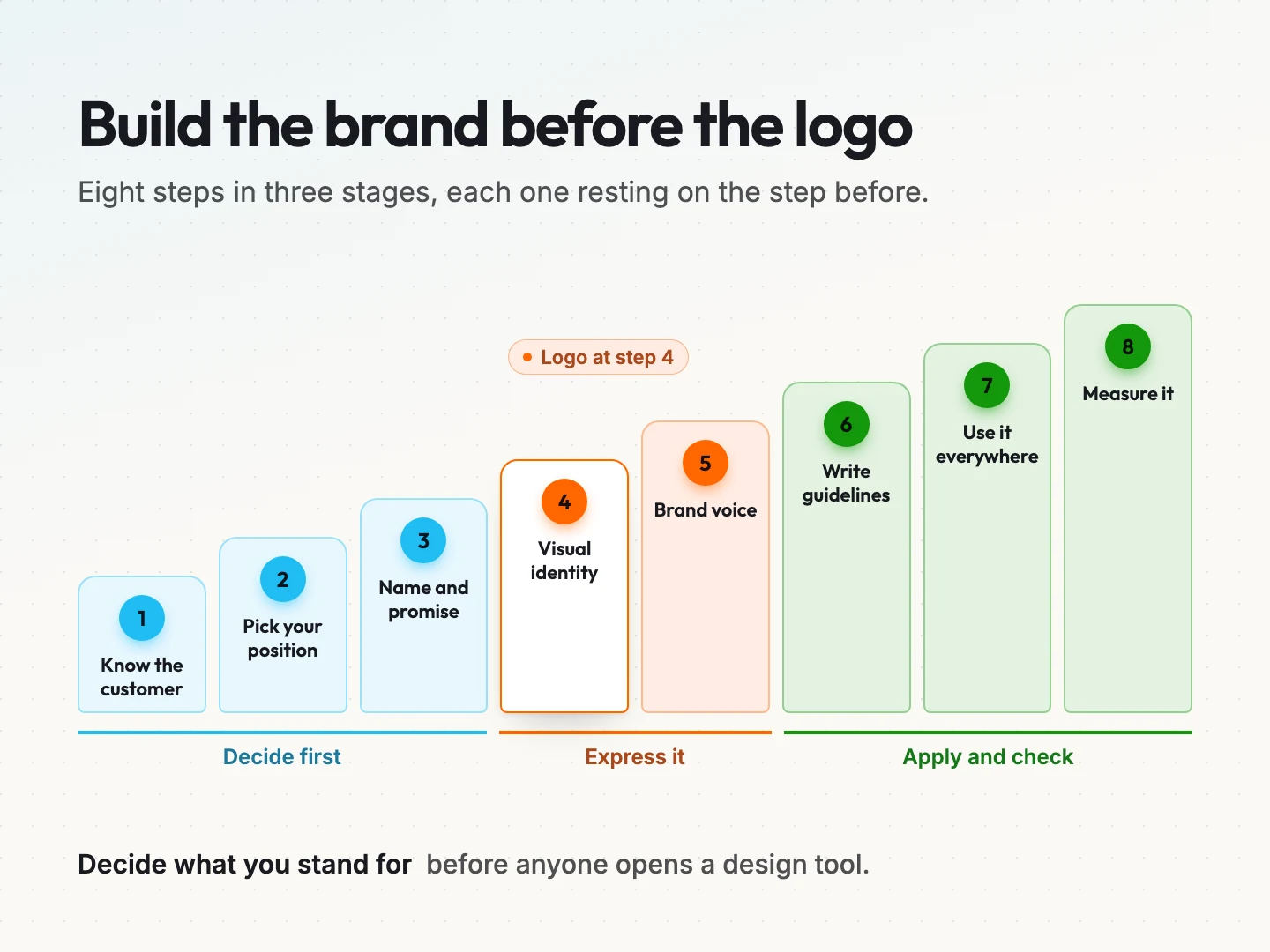
The eight steps fall into three stages. Steps 1 to 3 decide what the brand stands for. Steps 4 and 5 express it through look and voice. Steps 6 to 8 write it down, apply it and check it. Notice that the logo arrives at step 4, not step 1.
A brand is not a logo or a slogan.
Nor is it a favorite color. Those are tools. A business with a polished logo and a confusing sales process still has a weak brand, because the experience tells a different story than the mark. Equally, a plain logo can carry a strong brand when everything around it is consistent and the promise holds up.
Step 1: Describe the customer you serve best.
Start with people, not pictures. Your brand has to make sense to a specific customer in a specific situation, so describe that customer before you decide anything else.
Pick the customers you would gladly serve again. For each one, write down four things.
- The situation. What was happening in their business when they started looking for help?
- The decision. What were they choosing between, and what made it hard?
- Their words. Which phrases did they use to describe the problem? Write them down exactly.
- Their questions. What did they ask before they agreed to buy?
You do not need a research project for this. A handful of short conversations with recent customers will tell you more than a survey. Ask what nearly stopped them from buying and what made them say yes.
Look for patterns across the answers. If three customers describe the same worry in similar words, that worry belongs in your brand. Their language is often better than anything you would write yourself, because it is the language your next customer will search with.
Step 2: Position your business against real alternatives.
Positioning means choosing the place your business holds in the customer’s mind compared with the other options. A positioning statement is one sentence that names that place. You cannot position yourself in a vacuum, so start with the alternatives your customer weighs.
Those alternatives are rarely only direct competitors. A buyer might also consider a large agency, a freelancer, a do-it-yourself tool, a template shop or doing nothing at all. Each one solves the problem in a different way, at a different cost and with a different amount of the buyer’s own time.
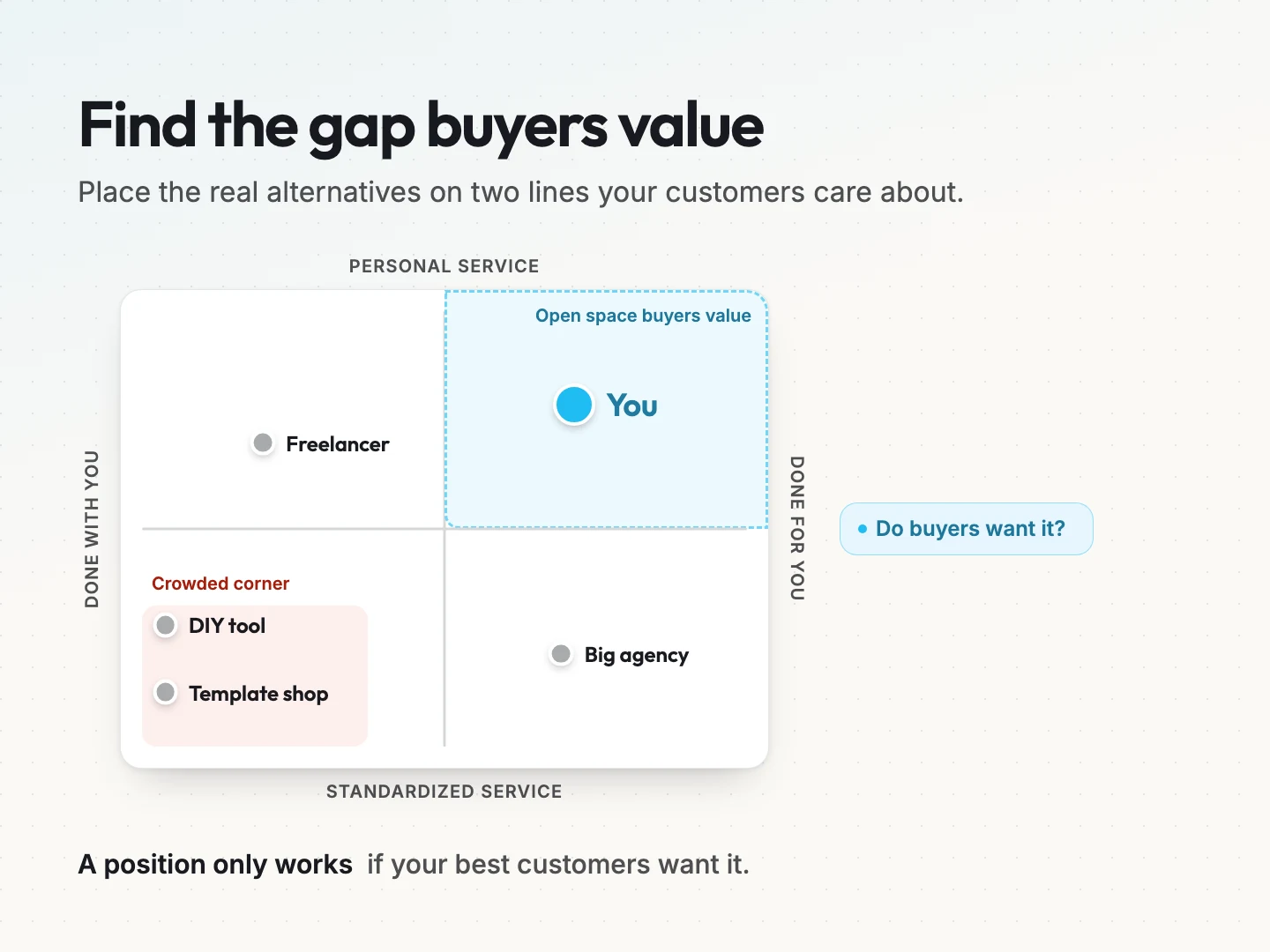
Draw a positioning map on paper.
Draw two lines that cross. Label each line with something your customers care about, taken from your notes in Step 1. Then place each alternative where it sits on both lines.
Here is a hypothetical example for a small local service business. One line runs from personal service to standardized service. The other runs from done with you to done for you.
A big agency sits in the done for you, standardized corner. A do-it-yourself tool sits in the standardized, done with you corner. A freelancer is personal, but the client usually still does part of the work. Template shops crowd in next to the do-it-yourself tool.
The open space on that map might be personal service that is fully done for you. That is a possible position. Whether it is a good one depends on one question: do your best customers value that gap enough to choose it?
Write one positioning sentence.
Turn the map into a sentence your whole team can repeat. A simple pattern works well.
> For [customer], [business] is the [category] that [difference], unlike [alternative].
Keep it plain. If the sentence needs a paragraph of explanation, it is not finished. This sentence is an internal tool, not a slogan, so it does not need to sound clever. If you want a structured outside view at this stage, a brand strategy service works through the same questions with interviews and competitor review.
Step 3: Choose a name and a promise you can keep.
With a customer and a position in hand, you can choose the words that carry them. The name is how people find and repeat you. The promise is what they expect when they do.
Check that the name is free to use.
A good name is short, easy to say and easy to spell after hearing it once. Before you fall in love with one, check whether you can use it.
- Search the USPTO trademark database for the name and close variations in your field.
- Check whether the matching domain is available, or a close version of it.
- Check the social handles you plan to use on each platform.
- Search your area in Google Maps for businesses with the same or a similar name, since a near match can confuse your Google Business Profile.
This is a first screen, not legal advice. The USPTO’s own search page points to guidance on searching for similar marks, which is a deeper job. If the name matters to your long-term plans, ask a trademark attorney before you print anything.
Write a promise your team can prove.
A brand promise is the one thing customers can count on every time they deal with you. It works only when your team can check it against how the work gets done.
Compare two hypothetical promises from a small accounting firm.
- One to reject. “We care about your success.” Nobody can test it, and every competitor says the same.
- One to keep. “You get a plain-language summary with every monthly report.” A customer can check it, and the team knows exactly what to do.
Test your draft promise against your scope and your process. If a busy week would break it, rewrite it until it would survive one.
Step 4: Build a visual identity that works at every size.
Visual identity is the look of your brand: logo, color, type and imagery. Because you made the decisions first, the designer can now work from your position and promise instead of personal taste.
Test every element where it will live. A logo that looks fine on a large screen can fall apart in these places.
- A small social profile picture.
- The header of an invoice or proposal.
- A sign seen from across a parking lot.
- A phone screen in bright daylight.
Color needs the same practical test. Check that text on your brand colors has enough contrast to read comfortably on your website, especially for buttons and small type.
The logo deserves its own careful process, from brief to final files. Our guide to the professional logo design process covers it step by step. For the full system of color, type and imagery around the mark, see the brand identity service or a dedicated logo design service.
Step 5: Give your brand a voice people recognize.
Voice is the personality of your words, and it stays the same everywhere. Tone is how that voice adjusts to the moment. You sound like the same person at a celebration and at a hard conversation, but you do not say things the same way.
A useful way to describe voice comes from the Nielsen Norman Group article The Four Dimensions of Tone of Voice by Kate Moran (published July 2016, last reviewed August 2023). It places tone on four scales.
| Dimension | One end | The other end |
|---|---|---|
| Humor | Funny | Serious |
| Formality | Formal | Casual |
| Respect | Respectful | Irreverent |
| Enthusiasm | Enthusiastic | Matter-of-fact |
Mark where your brand sits on each line. A caveat matters here. The article offers a way to describe tone and reports a small user study of how people perceived it. It does not show that any position on these scales wins more customers.
Write a “we say, we never say” list.
Turn your marks into examples. Write a few sentences your brand would use and a few it would reject. A hypothetical plumbing company might say “We will be there between 2 and 4, and we will text when we leave.” It would never say “Your satisfaction is our top priority.”
Let tone shift without losing the voice.
Your voice stays fixed while your tone flexes. A sales page can be warm and confident. A support reply should be calm and specific. A response to a bad review should be respectful and brief. All three still sound like you, because the vocabulary, the plainness and the attitude stay the same.
Step 6: Write brand guidelines your team will actually open.
Brand guidelines are the written rules for using your brand. Many small businesses skip them because they picture a thick document nobody reads. A small team needs something much shorter: one page, or a short deck, that anyone can open in a minute.
A one-page outline can hold everything that matters.
- Promise. The one sentence from Step 3.
- Positioning sentence. The one sentence from Step 2.
- Voice rules. Your four tone marks and the “we say, we never say” list.
- Logo use. Which version goes where, the smallest allowed size and what never to do with it.
- Color and type. The exact color values and fonts, with one line on when to use each.
- Three good examples. A real email, social post or proposal page that gets it right.
Give the page an owner. One person decides on changes, keeps the files current and tells the team when something updates. Without an owner, guidelines drift out of date within a year.
If your business has several people creating content, or you work with outside designers, a fuller set of rules saves time. A brand guidelines service can turn your decisions into a document built for that.
Step 7: Carry your brand across your website and social profiles.
A brand becomes real at touchpoints, meaning every place customers meet you. Most businesses think of the website and social media first. Customers also meet you in places you might not think of as branding.
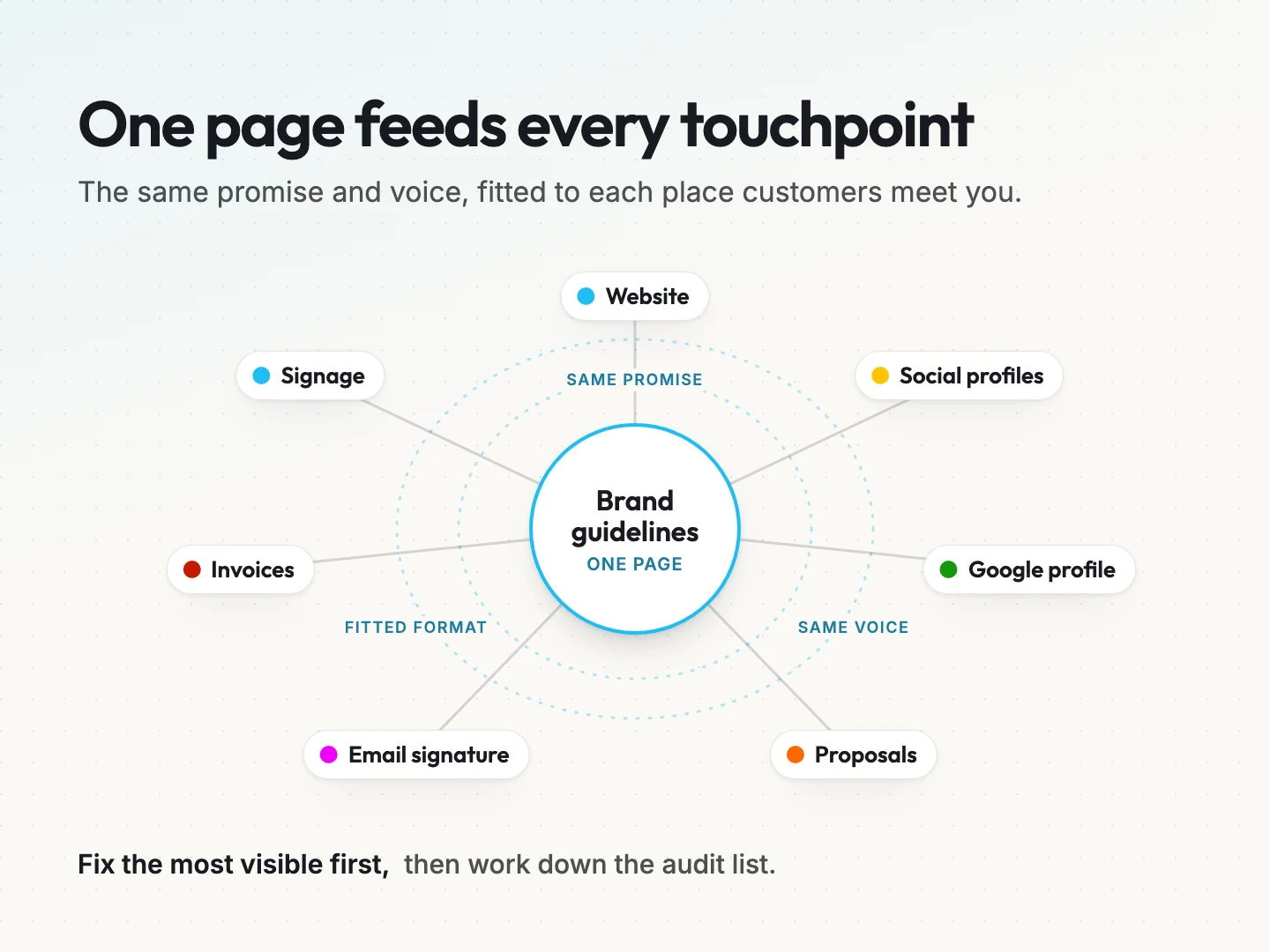
Run a touchpoint audit.
List every place a customer sees, hears or reads your business. Then check each one against your one-page guidelines. Service businesses should include these.
- Website and landing pages.
- Social profiles and posts.
- Google Business Profile, including the description and replies to reviews.
- Proposals and quotes.
- Email signatures.
- Invoices and receipts.
- Signage, vehicles and printed pieces.
- The phone greeting and voicemail message.
Mark each touchpoint as on brand, partly on brand or off brand. Then sort by how many people see it. Fix the most visible gaps first. A mismatched website header reaches far more people than an old letterhead in a drawer.
Consistent does not mean identical.
Consistency is about the promise and the voice, not about copying the same layout everywhere. An invoice and an Instagram post look different, and they should. What stays the same is the name, the core colors, the way you talk and what you commit to. Each format fits the space it lives in.
Your website carries more of this load than any other touchpoint, because most buyers check it before they contact you. Our guide to website design that increases sales covers the structure that turns visits into inquiries. If your site needs a rebuild to match the new brand, see the web design service.
Owners as the face of the brand on social.
Many small businesses are known through the owner. That is an asset, as long as your personal posts and the business brand point the same way. Your personal voice can be looser, but the promise should match. Our guide to personal branding on social media covers how to build that side of it.
Step 8: Check whether your brand is working.
Many owners assume you cannot measure a brand. You can, with a few simple checks and some patience. The key is to set a baseline before you change anything, then compare over a fixed window, such as each quarter.

Think of brand strength as a funnel. People first recognize you, then remember you, then search for you, then choose you and finally recommend you. Each stage has a check a small team can run.
| Stage | Check | How to run it |
|---|---|---|
| Recognized | Five-second recall test | Show your homepage to someone outside the business for five seconds, then ask what you do and for whom |
| Remembered | “How did you hear about us?” | Add the field to your contact form and ask it on the phone |
| Searched | Branded searches | Track searches that include your name in Google Search Console |
| Chosen | Inquiries that name you | Count inquiries that mention your business by name or a referral |
| Recommended | Words in reviews | Read new reviews for the words in your promise |
Track branded searches in Search Console.
A branded search is a search that includes your business name. Rising branded searches usually mean more people remember you. In Google Search Console, open the Performance report, which shows clicks, impressions, click-through rate and average position. Google’s Performance report help page explains the basics.
To split branded from other searches, add a query filter for “Queries containing” your name. Google’s guide to analyzing performance shows this method. It also notes that anonymized queries drop out when you filter by query, so treat the totals as a rough trend rather than an exact count.
A worked example with round numbers.
Here is a hypothetical example. A small landscaping company records a baseline in one quarter. It sees 100 branded search clicks. Ten inquiries name the business, and two reviews use the phrase “on time” from its promise.
After a quarter of consistent work, it sees 150 branded clicks, 15 named inquiries and five reviews mentioning timeliness. None of these numbers proves the brand caused the change. Together, they show the trend is moving the right way.
Follower counts are missing from this list on purpose. Followers can rise while inquiries stay flat. Put recall, branded searches and named inquiries ahead of follower numbers when you judge your brand.
Refresh or rebuild: what your brand needs now.
If you already have a brand, you may not need to start over. The right choice depends on what changed in the business, not on how old the logo is.
| What changed | What it usually needs |
|---|---|
| Only the look feels dated, and the promise still fits | A refresh: update the logo, colors and type, and keep the name and promise |
| The voice drifted across people and channels | A refresh: rewrite the voice rules and guidelines, then rerun the touchpoint audit |
| Your customer changed, such as moving from consumers to businesses | A rebuild: start again at Step 1 |
| Your offer changed, such as new services that no longer fit the name | A rebuild of the position and promise, and possibly the name |
| Your promise no longer matches how the work gets done | Fix the process or the promise first, then refresh the expression |
Use your Step 8 checks to decide. If people still recall you correctly and the right customers still name you, a refresh is usually enough. If recall is confused or the wrong customers keep calling, the problem sits deeper than the look.
The cost of professional brand work.
You can do much of this work yourself, especially Steps 1, 2 and 8. Many owners bring in help for the identity, the voice and the guidelines, where design skill and an outside view save time.
For reference, the Scayver Graphix branding service has three starting points.
- Starter Branding starts at $2,599: one logo concept, one revision, web and print files.
- Growth Branding starts at $4,599: a broader identity, with a brand guide after the identity work.
- Premium Branding starts at $8,599: adds specified activation materials.
These are starting prices. Scope decides the final quote, including how many touchpoints need new materials and whether naming is part of the work.
Final thoughts on building your brand.
A brand gets built through decisions made in order, and the logo is only one of them. Start with the customer you serve best. Choose a position against the real alternatives, and make a promise your team can prove. Then express it, write it down on one page and apply it everywhere.
Step 8 is what stops this from turning into guesswork. Set your baseline now, so that a quarter from today you can see whether people remember you, search for you and choose you.
Not sure where to start? Run the touchpoint audit from Step 7 and note the first gap you find. Then talk to a specialist about closing that gap first.
Was this article helpful?

