A marketing campaign brief template is a one-page document your team fills in before anyone builds an asset. It fixes nine things. They are the basics, the business problem, the audience, the offer, one counted action, the message, each channel’s job, the budget and capacity, and every open decision with a named owner.
For a small team, the offer, the counted action and the channel jobs matter most. When three people run email, social, ads and the landing page between other jobs, nobody has time to rebuild an asset because the offer changed on day four. A good brief settles all three before the first word of copy.
This guide walks through each field, shows you a filled example for a hypothetical business and gives you a template and a launch checklist you can copy into a document today.
The job of a marketing campaign brief.
A campaign brief is the single source of truth for one campaign across every channel. It answers what you are offering, to whom, what you want them to do and how each channel helps them do it. Everyone who touches the campaign reads the same page.
It sits between two documents you may already have. A marketing plan covers the whole year and every goal. A creative brief covers one asset, such as an ad, a video or a landing page. The campaign brief connects them. It takes one goal from the plan and tells each creative brief what it must serve.
If you already use a creative brief, keep it. Our one-page creative brief template works well for a single asset. The campaign brief comes first and feeds it.
Small teams need a brief more than big teams.
A large marketing department has a project manager whose job is to catch mismatches. A small team usually does not. The owner approves the offer in a hallway, the person writing emails hears a different version and the ad goes live with a third.
The brief is your project manager on paper. It takes about an hour to fill in. That hour replaces the rework, the mixed messages and the end-of-month argument about whether the campaign worked.
A brief is not a plan or a pitch.
A brief is not a pitch deck and not a strategy essay. If a field needs more than three sentences, the thinking behind it is not finished yet. Keep the brief short enough that everyone reads all of it.
The nine fields of a campaign brief template.
Most templates you will find online cover objectives, audience, message, deliverables, budget and timeline. Those are useful. What they usually leave out are the three fields that decide whether channels pull in the same direction: one counted action, a job for each channel and a log of open decisions.
The template below groups nine fields into three parts. The first part says why the campaign exists. The second says what you are asking people to do. The third says how the team will get it done.
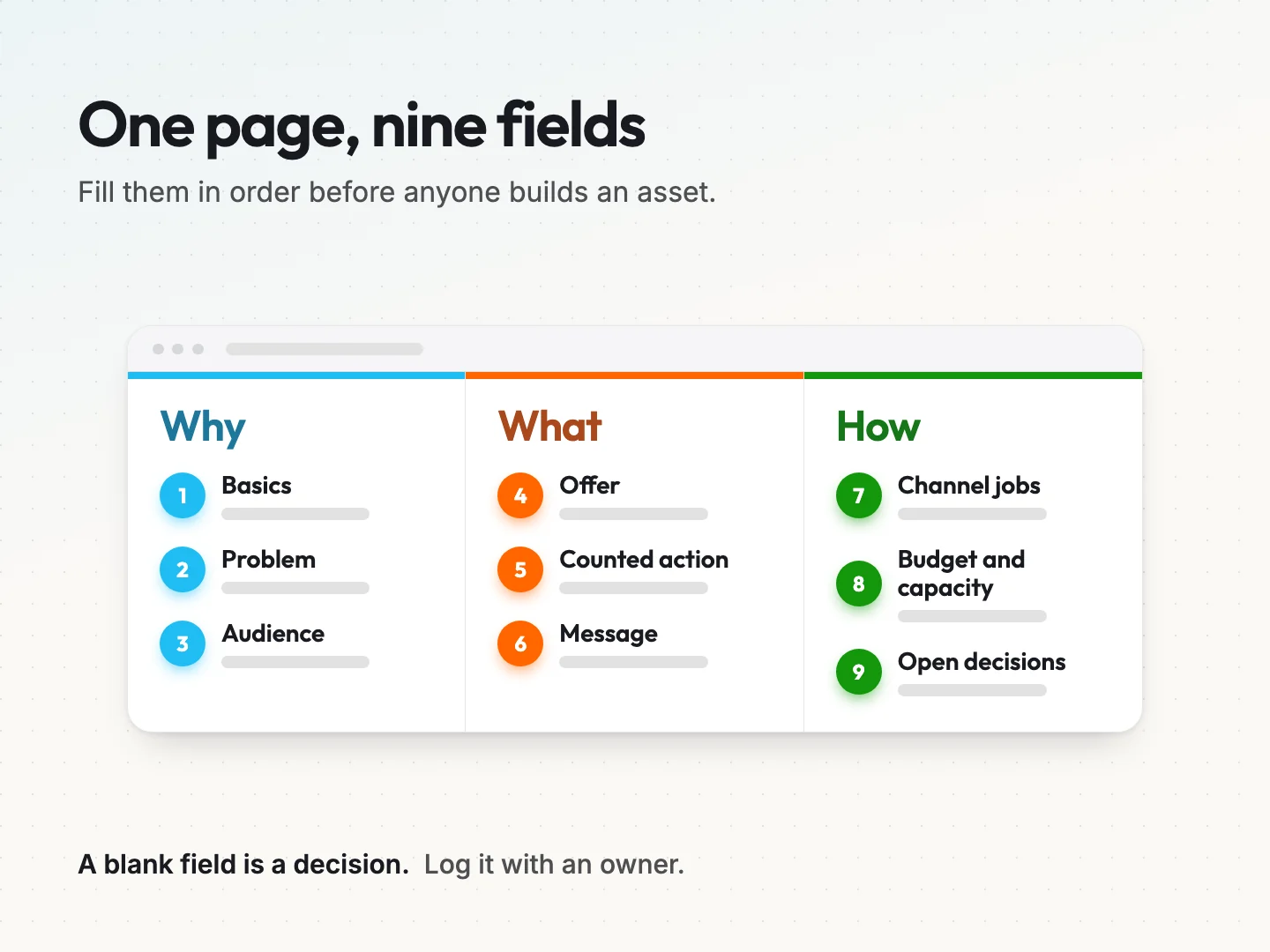
Here is what each field holds.
- Campaign basics. The name, the start date, the end date and the person who owns the campaign overall.
- Business problem. One or two sentences on why this campaign exists now, such as a slow season, a new service or a list that has gone quiet.
- Audience. One primary group, described by the situation they are in, not only by age or location.
- Offer. What the person gets, the terms and the date it ends.
- Counted action. The one action you will count as a result, and the place it is counted.
- Message. The single promise, the proof behind it and the tone.
- Channel jobs. Each channel, its one job, the asset it needs, its owner and its tagged link.
- Budget and capacity. Spend by channel, staff hours and how many results the business can serve.
- Open decisions. Every question still unanswered, with an owner, a due date and a default.
The order is deliberate. You cannot write a message until the offer is fixed. You cannot give a channel a job until you know the action it serves.
Write the offer before anyone writes copy.
The offer is the part of the brief that changes most often, and every change costs you assets. Write it as one sentence a customer could repeat to a friend. Then add the terms and the end date underneath.
A weak offer line reads like a theme, such as “spring savings event”. A strong one reads like a deal a person can act on. For example, a hypothetical line might read “Book a spring tune-up before April 30 and get a written report on your system”.
Three checks for the offer line.
Run these three checks before you move on.
- Can a customer repeat it? If the sentence needs a footnote, it is too complicated for a social post or a radio spot.
- Does it have an end date? An offer without an end date gives people no reason to act this week.
- Can the business deliver it? Ask the person who does the work, not only the person who sells it.
Write down what the offer excludes.
Exclusions belong in the brief too. If the offer excludes commercial properties, repeat customers or a certain product, say so here. Otherwise the person answering the phone learns about the exclusion from an annoyed customer.
Choose one counted action and say where it is counted.
The counted action is the one thing a person does that you will count as a campaign result. It is usually a booking, a purchase, a quote request or a signup. Pick one, and write down the exact place where it gets counted.
Teams get into trouble when every channel reports its own number. Email reports opens, social reports likes, ads report clicks and the website reports visits. All four can rise while bookings stay flat. Those are signals worth watching, but only one number is the result.
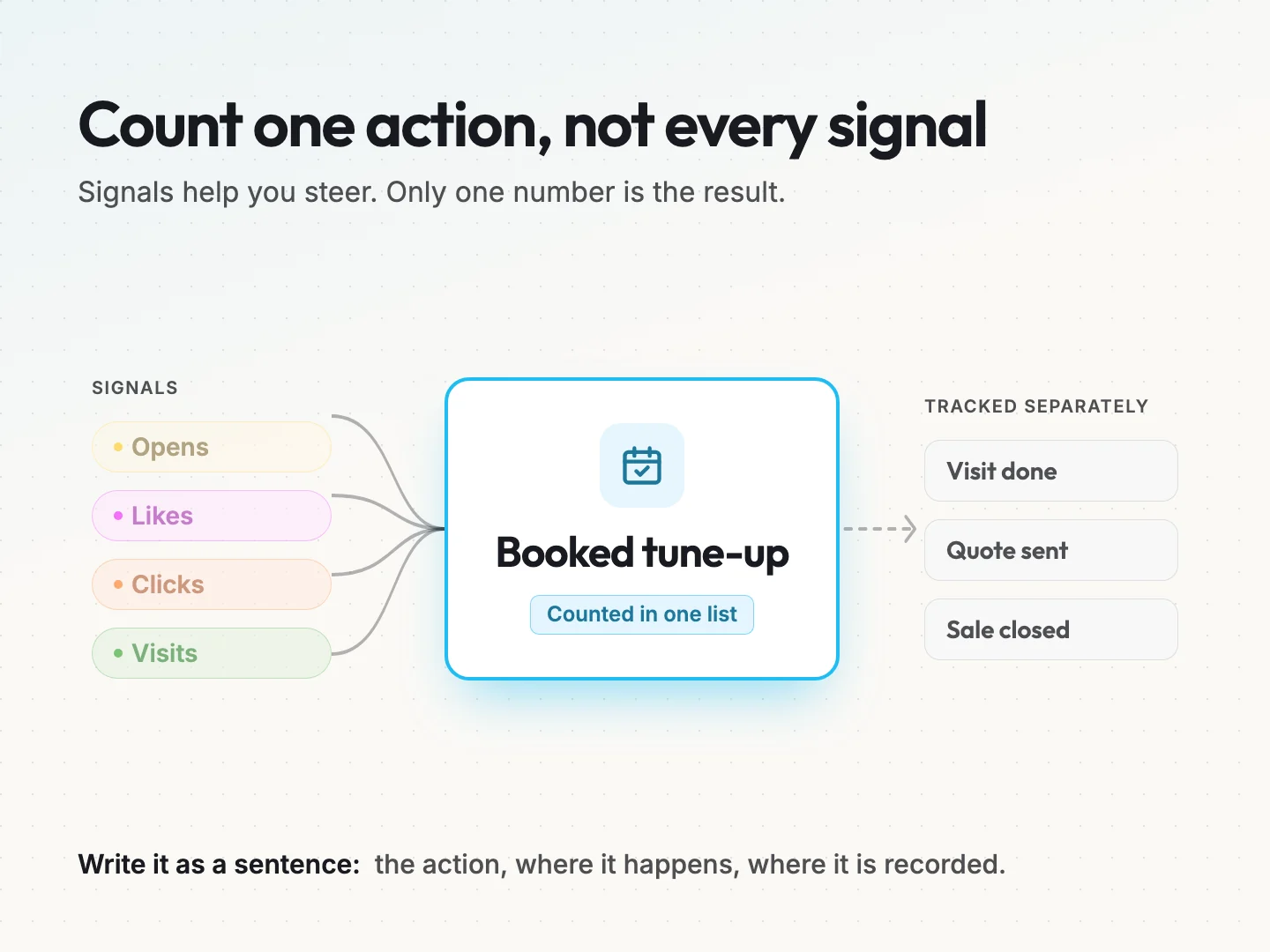
Write the counted action as a full sentence.
A useful counted action names three things: the action, where it happens and where it is recorded. For example, “A completed booking form on the tune-up page, recorded as a booking in our scheduling tool.” Phone calls count only if someone logs them in the same place.
If people can act in two ways, such as a form and a phone call, decide now whether both count. Then make sure both land in one list. Two lists in two tools turn the end-of-campaign review into a guessing game.
Keep later steps separate from the count.
What happens after the action still matters. A booking might lead to a visit, a quote and a sale. Track those steps, but do not fold them into the campaign count. The campaign’s job is to produce the action. Turning bookings into sales is the job of your sales and service process.
Keeping them separate tells you where a problem lives. Plenty of bookings and few sales points to the follow-up. Few bookings points to the campaign.
Tag every link so you can count by channel.
To know which channel produced each action, tag the links each channel uses. Google calls these UTM parameters, short labels added to the end of a link. The Google Analytics Help page on campaign URLs says to always include utm_source, utm_medium and utm_campaign, and to keep one strict naming format, because values are case sensitive.
Write the campaign value in the brief so every channel uses it exactly. The short resource on how to track campaign links cleanly covers the naming rules in more detail.
Give every channel one job.
A channel job is the single task one channel does to move a person toward the counted action. Write it as a verb and a reason. Email reminds past customers. Social shows the result. Search ads catch people who are already looking.
When each channel has one job, the assets get simpler. The email does not try to explain everything. The ad does not try to tell the brand story. Each piece does its part and hands the person to the next step.

Fill in the channel job table.
For each channel, fill in one row with five columns.
| Channel | Job | Asset | Owner | Tagged link |
|---|---|---|---|---|
| Remind past customers | Two emails | Marketing lead | utm_medium=email | |
| Social | Show the result | Three posts | Marketing lead | utm_medium=social |
| Search ads | Catch searchers | One ad group | Ads contractor | utm_medium=cpc |
| Landing page | Take the booking | One page with form | Web contact | Not needed |
| Phone | Confirm by phone | Call script | Front desk | Logged by hand |
Each row ends at the same place, the counted action. If a channel cannot point to it, ask whether that channel belongs in this campaign at all.
Fewer channels done well beat more channels done halfway.
A small team rarely has the hours to run six channels properly. Pick the two or three where your audience already pays attention and give them full effort. A channel you add only because it exists will produce weak assets and confuse the count.
If you want the bigger picture of how channels support each other across a year, our guide to integrated marketing for small business covers the strategy side. The brief is where that strategy turns into one campaign’s work.
The landing page carries the most weight.
Most channels in a small campaign send people to one page. That page has to repeat the offer in the same words, show the same end date and make the counted action easy. If the email says “before April 30” and the page says “this spring”, people hesitate. A well built landing page design keeps that promise consistent.
Name an owner for every open decision.
Every brief starts with questions nobody has answered yet. Will phone calls count? Who approves the ad copy? What happens if bookings fill the schedule in week one? Unanswered questions do not stop a launch. They quietly change it.
The open decision log fixes that. Each open question gets a row with an owner, a due date and a default. The default is what happens if nobody decides by the due date. That way the campaign keeps moving and nobody waits on a reply that never comes.
| Open decision | Owner | Due | Default if not decided |
|---|---|---|---|
| Do phone bookings count? | Owner | Day minus 7 | Yes, if logged in the scheduling tool |
| Who approves ad copy? | Marketing lead | Day minus 7 | Marketing lead approves |
| What if the schedule fills? | Service manager | Day minus 3 | Pause ads, keep email |
| Is the offer open to past customers? | Owner | Day minus 10 | Yes |
A default keeps the campaign moving.
Without a default, an open decision blocks someone. With a default, it only needs attention if the owner disagrees. Most small teams find that the default is usually right, and the log shrinks quickly.
Plan for capacity before you launch.
The schedule question deserves its own line. A campaign that brings in more bookings than your team can serve hurts your reputation. Write down how many results the business can handle each week, and decide in advance what you will pause if you reach it.
The campaign brief template to copy.
Copy the template below into a shared document. Fill in every row before you brief a designer or a writer. If a field is blank, add it to the open decision log instead of guessing.
| Field | What to write | Your answer |
|---|---|---|
| Campaign name | A short name everyone will use, also your utm_campaign value | |
| Dates | Start date, end date and review date | |
| Campaign owner | One person who makes the final call | |
| Business problem | Why this campaign, why now, in two sentences | |
| Audience | One primary group and the situation they are in | |
| Offer | One repeatable sentence, terms and end date | |
| Exclusions | Who or what the offer does not cover | |
| Counted action | The action, where it happens and where it is recorded | |
| Tracked separately | Later steps you watch but do not count as the result | |
| Message | One promise, the proof behind it and the tone | |
| Channel jobs | One row per channel: job, asset, owner, tagged link | |
| Budget | Spend by channel and staff hours | |
| Capacity | How many results the business can serve each week | |
| Open decisions | Question, owner, due date and default | |
| Launch checks | The checklist below, with a name next to each item |
Use the template as a team.
Ask the campaign owner to draft the brief alone first. A draft gives people something to react to, which is faster than filling a blank page in a meeting. Then share it with everyone who owns a channel and give them one day to add questions to the open decision log.
Hold one short meeting to settle the log. When every decision has an answer or a default, the brief is ready. Treat any later change to the offer or the counted action as a new version, and tell every channel owner.
A filled campaign brief example.
Here is the template filled in for a hypothetical heating and cooling company. The business, the offer and every figure are invented to show how the fields work together. They are not results from a real campaign.
| Field | Hypothetical answer |
|---|---|
| Campaign name | spring-tuneup |
| Dates | April 1 to April 30, review on May 7 |
| Campaign owner | The owner |
| Business problem | April is a slow month for repairs, and the team has open hours before summer. |
| Audience | Homeowners in the service area who have not had a system check in the past year. |
| Offer | Book a spring tune-up before April 30 and get a written report on your system. |
| Exclusions | Commercial properties and systems under an existing service plan. |
| Counted action | A completed booking on the tune-up page or a phone booking logged in the scheduling tool. |
| Tracked separately | Completed visits, repair quotes and accepted quotes. |
| Message | A short visit now means fewer surprises in July. Proof: the written report the customer keeps. Tone: plain and calm. |
| Channel jobs | Email reminds past customers. Social shows a sample report. Search ads catch people searching for a tune-up. The landing page takes the booking. The front desk confirms by phone. |
| Budget | Ads spend set by the owner, about six staff hours a week for the campaign. |
| Capacity | 40 tune-ups a week across two technicians. |
| Open decisions | Phone bookings count, decided. Ad copy approval, the marketing lead. Full schedule, pause ads and keep email. |
| Launch checks | Assigned in the checklist below. |
The example keeps each field narrow.
Notice how each field narrows the next. The offer has an end date, so the message can create a reason to act now. The counted action names one list, so the review will compare like with like. The capacity line tells the team when to slow down before the schedule overflows.
Notice also what it leaves out. There is no brand story, no list of every possible channel and no long background section. A brief that fits on one page gets read by everyone.
Add a welcome sequence if you collect emails.
If the campaign collects email addresses, the follow-up emails belong in the brief too. A short email welcome sequence template helps when the counted action is a signup rather than a booking.
Campaign launch checklist for the last 10 days.
A campaign launch checklist turns the brief into a countdown. Each check has a day and an owner. Work back from launch day so nothing waits until the final afternoon.
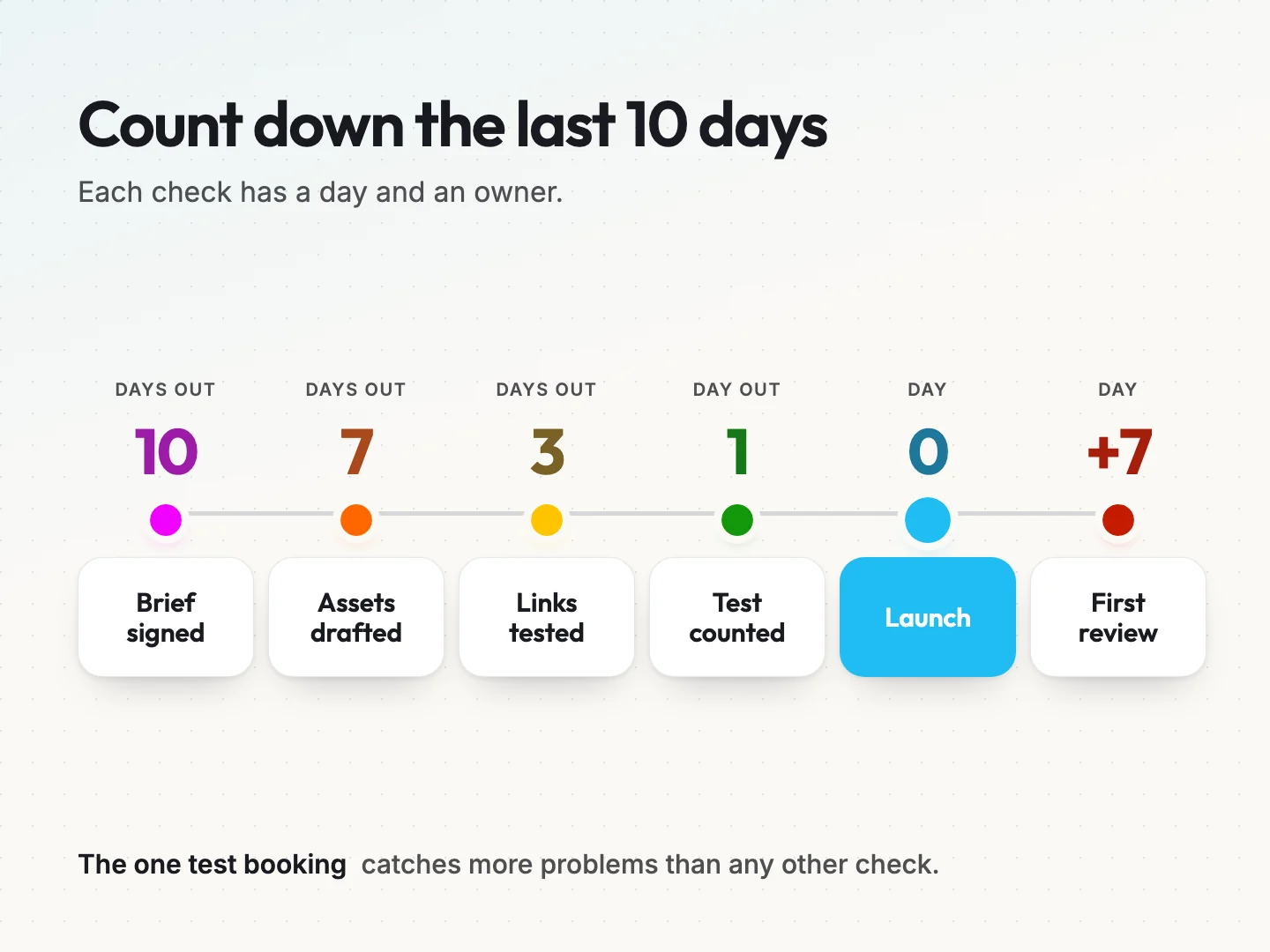
Day minus 10: sign the brief.
The campaign owner confirms the offer, the end date and the counted action. Open decisions all have an owner and a due date. From here, a change to the offer counts as a new version.
Day minus 7: assets drafted.
Every channel owner has a first draft of each asset in the channel job table. The landing page repeats the offer in the same words and the same end date. Ad copy approval happens today.
Day minus 3: links and forms tested.
Click every tagged link from a phone and a computer. Submit the form yourself and confirm the booking lands in the right list. Call the phone number and check the front desk knows the offer, the exclusions and how to log a booking. If you plan to run paid ads, work through our marketing checklist as well.
Day minus 1: one test counted.
Make one test booking from start to finish and confirm it appears exactly once in the count. Then delete it or mark it as a test. This single check catches more launch problems than any other step.
Day 0: launch.
Send the first email, publish the first post and turn on the ads. Check the count at the end of the day. A day with clicks and no bookings usually points to the landing page or the form.
Day 7: first review.
Compare the count by channel using the tagged links. Check the capacity line against the schedule. Change one thing at a time, and write the change into the brief so the end-of-campaign review knows what happened when.
After the end date: close the brief.
On the review date, write three lines at the bottom of the brief. What was the count, which channel produced the most actions and what would you change next time? That short note makes your next brief faster and better.
Final thoughts.
A campaign brief does not need to be long to work. It needs to settle the offer, name the one action you will count and give every channel a single job that points at it. The open decision log keeps the questions from turning into surprises, and the countdown keeps launch day calm.
Start with your next campaign, even a small one. Copy the template, fill in the nine fields and share it with everyone who touches the work before anyone designs a thing. You will spend an hour on the brief and save far more than that in rework.
If you would like a team to plan and run the campaign with you, our campaign management service covers the brief, the channels and the review. To talk through your next campaign, book a call with a specialist.
Was this article helpful?