Podcast episode planning means deciding what your listener should be ready to decide or do after the episode, before you invite anyone. Pick one listener decision, test three angles with different jobs, then write six interview prompts and the host’s opening and close. Only then book the guest who fits that plan.
Most small business podcasts get planned the other way round. Someone interesting agrees to come on, a date goes in the calendar and the questions get written the night before. The conversation can still be pleasant. It tends to wander, though, because nobody decided what the episode was for.
This guide gives you a planning order that fixes that, plus an episode brief template you can copy into a document and reuse for every show. It works for audio or video, and for a solo host or a pair of cohosts.
Podcast episode planning starts before the invitation.
An invitation is a promise. Once a guest says yes, you feel obliged to make the episode about them, their story and their business. That suits a celebrity interview show. For a business podcast meant to help customers, it puts the guest’s agenda ahead of the listener’s problem.
Planning first changes three things. You know which guest to ask, because you know what expertise the episode needs. You can tell the guest exactly why you want them, which makes a clear yes more likely. You can also turn down guests who would be interesting but wrong for this particular episode.
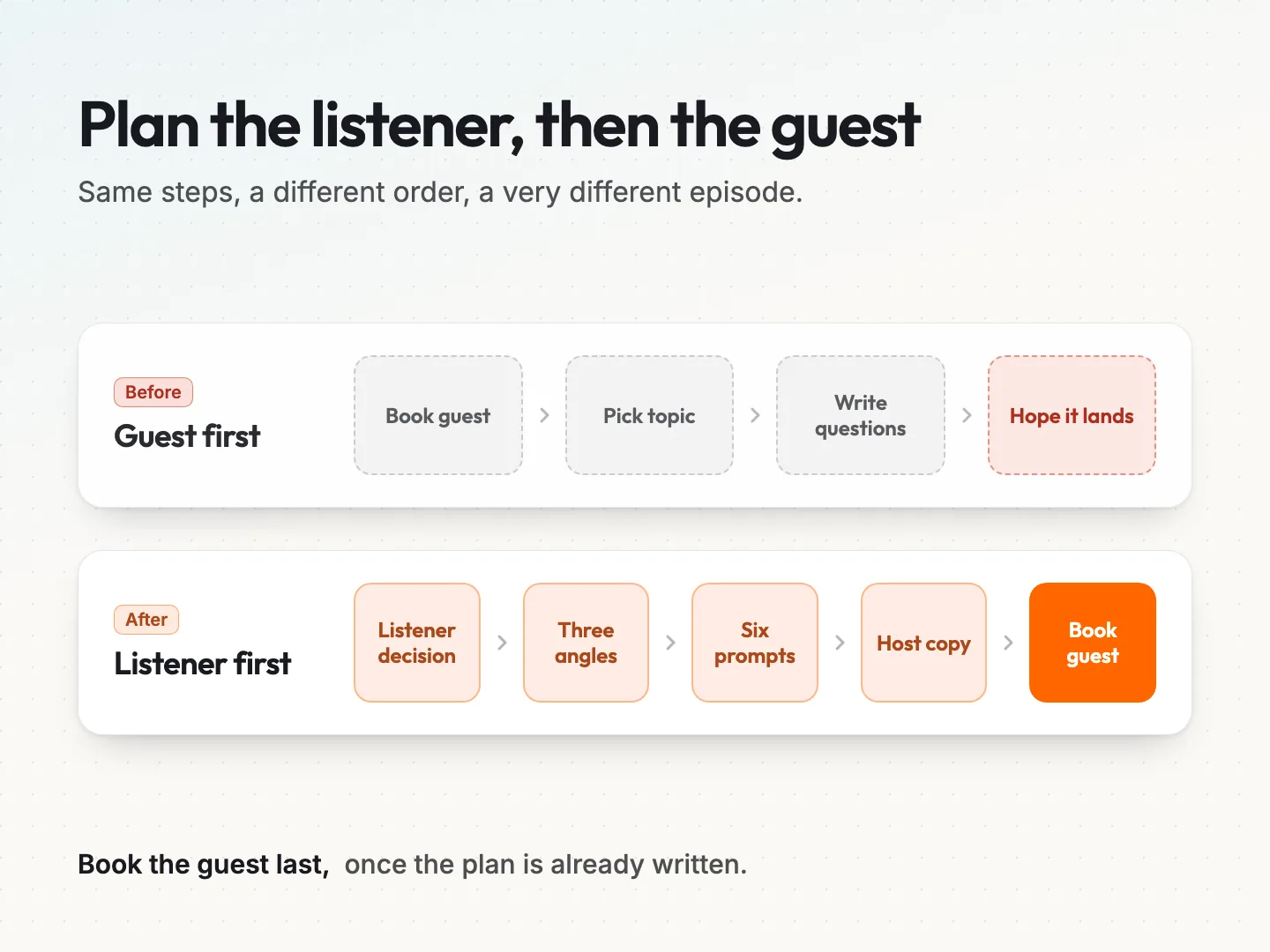
Here is the order this guide follows.
- Name the listener and the decision the episode supports.
- Write three angles and give each one a different job.
- Pick one angle and list the expertise it needs.
- Write six interview prompts and the host copy.
- Find and invite the guest who fits.
- Confirm permissions and recording checks.
The first four steps happen at your desk, with nobody else involved. That is the point. By the time you contact a guest, the hard thinking is done and the request is easy to explain.
Decide the listener decision the episode supports.
A listener decision is the choice or action someone should be ready to take when the episode ends. It is narrower than a topic. “Marketing for contractors” is a topic. “Whether a roofing company should reply to every online review” is a decision.
Write it as one sentence with three parts: who is listening, what they are deciding and what they should walk away with. Here is a hypothetical example. “A restaurant owner deciding whether to add online ordering should know the three costs to check first.” The shape works for almost any business.
Test the decision before you go further.
Read your sentence and ask three questions.
- Would a real customer or prospect recognize this as their problem?
- Can one conversation move them toward a choice?
- Could you tell, after recording, whether the episode delivered it?
If any answer is no, narrow the sentence. A decision that is too broad produces an episode that covers everything and settles nothing. A decision that is too narrow usually fails the first question, because nobody outside your team has that problem.
Keep the listener in plain view.
Put the sentence at the top of your brief and leave it there. Every later choice gets checked against it, including which answers survive the edit. Buzzsprout’s guide to podcast interview questions (Alban Brooke, January 2026) suggests deciding the one thing each episode should convey. This guide moves that choice ahead of the booking, so it shapes who you invite.
Give three angles three different jobs.
An angle is the route an episode takes to reach the listener decision. The same decision can be approached in quite different ways, and the angle decides which guest you need. Writing three angles stops you from settling on the first idea that comes to mind.
Give each angle a different job. That way you compare real options rather than three versions of the same idea.
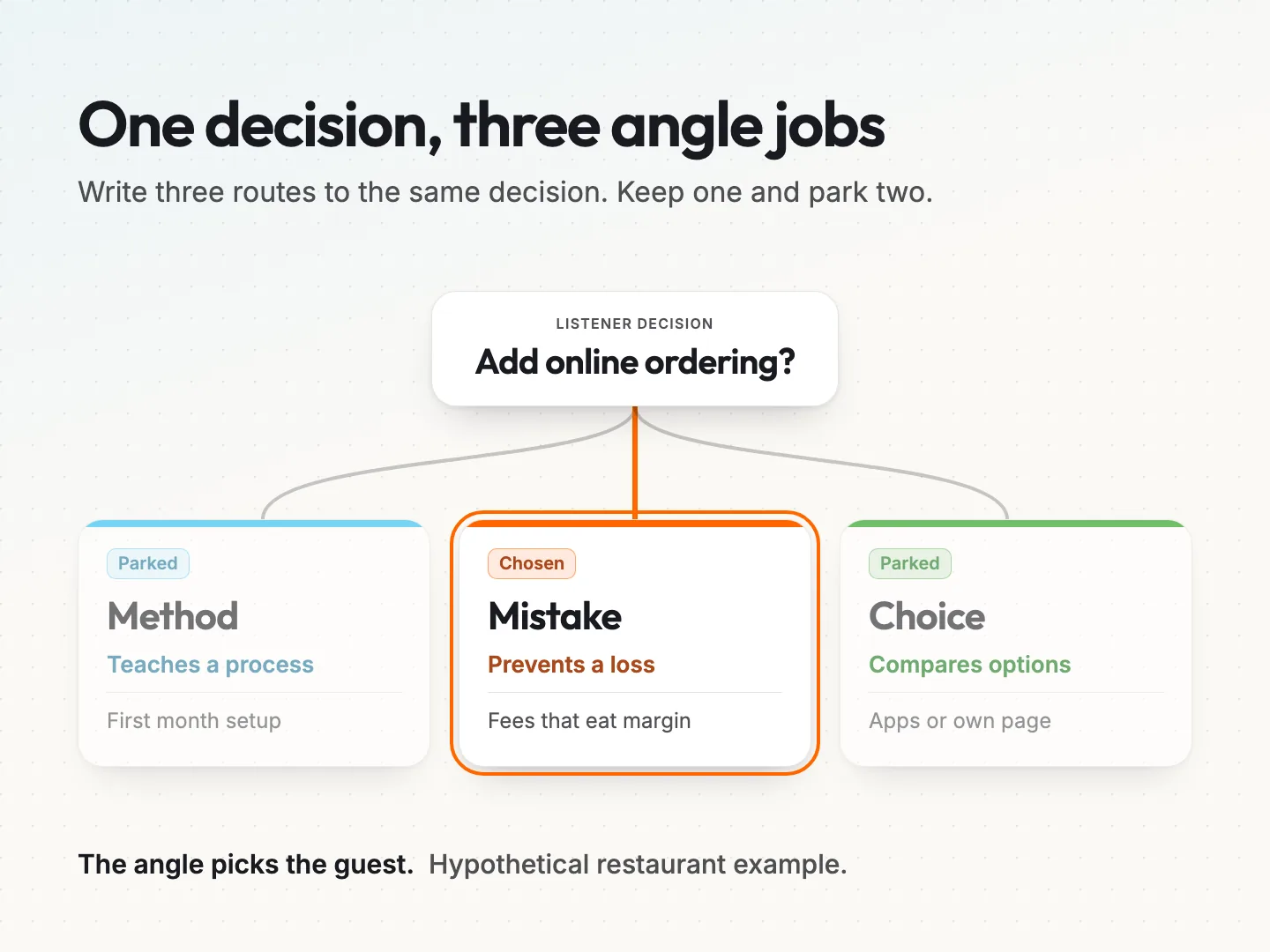
The method angle teaches a process.
The episode walks the listener through how something is done, step by step. It suits a guest who does the work every day and can explain it in order. For the online ordering example, the method angle is how a small restaurant sets up online ordering in its first month.
The mistake angle prevents a loss.
The episode covers what goes wrong and how to avoid it. It suits a guest who has cleaned up after other people’s errors, such as a consultant or an accountant. In the example, it becomes the ordering fees and setup errors that quietly eat into a restaurant’s margin.
The choice angle compares options.
The episode helps the listener pick between two or more paths. It suits a guest who has seen several options in practice and can stay neutral. In the example, it becomes third party apps or your own ordering page, and how to decide between them.
Pick one angle and park the others.
Choose the angle that serves the decision sentence most directly. Then save the other two in a running list of future episodes. One good decision sentence can often supply two or three episodes this way, which makes your content calendar easier to fill.
Under the chosen angle, write one line naming the expertise it needs. “Someone who has set up online ordering for several small restaurants” is specific enough to search for. “A restaurant expert” is not.
Choose a guest who fits the angle.
Now you look for a person. Start from the expertise line, not from a list of well known names. The Podcast Host’s interview preparation guide (Colin Gray, updated November 2024) recommends searching for ideas rather than people, then finding the guest with a distinct approach. That advice is far easier to follow once the angle is set.
Use this short fit check before you send any invitation.
| Question | Good sign | Warning sign |
|---|---|---|
| Do they do the work the angle needs? | They describe real projects in general terms. | They mostly talk about their own brand. |
| Can they explain things in order? | Past talks or posts walk through steps. | Answers jump between ideas. |
| Will they stay useful to your listener? | They teach without a pitch. | Every answer leads back to their offer. |
| Can they speak freely? | They can share examples without breaking confidences. | An employer or client limits what they can say. |
You do not need a famous guest. A trusted supplier, a long time customer or someone on your own team can be the right fit for a decision your listeners face. A guest who matches the angle will usually give a more useful episode than a bigger name who does not.
Write six interview prompts before anyone is invited.
Writing the questions before the booking sounds backwards. It is the step that saves the most time later, because the prompts show you whether the angle holds up. If you struggle to write six useful prompts, the angle is probably too thin for a full episode.
A prompt is more than a question. It names what you want the guest to give the listener, so you can steer back when an answer drifts. Six prompts fill a typical interview and still leave room for natural follow up questions.
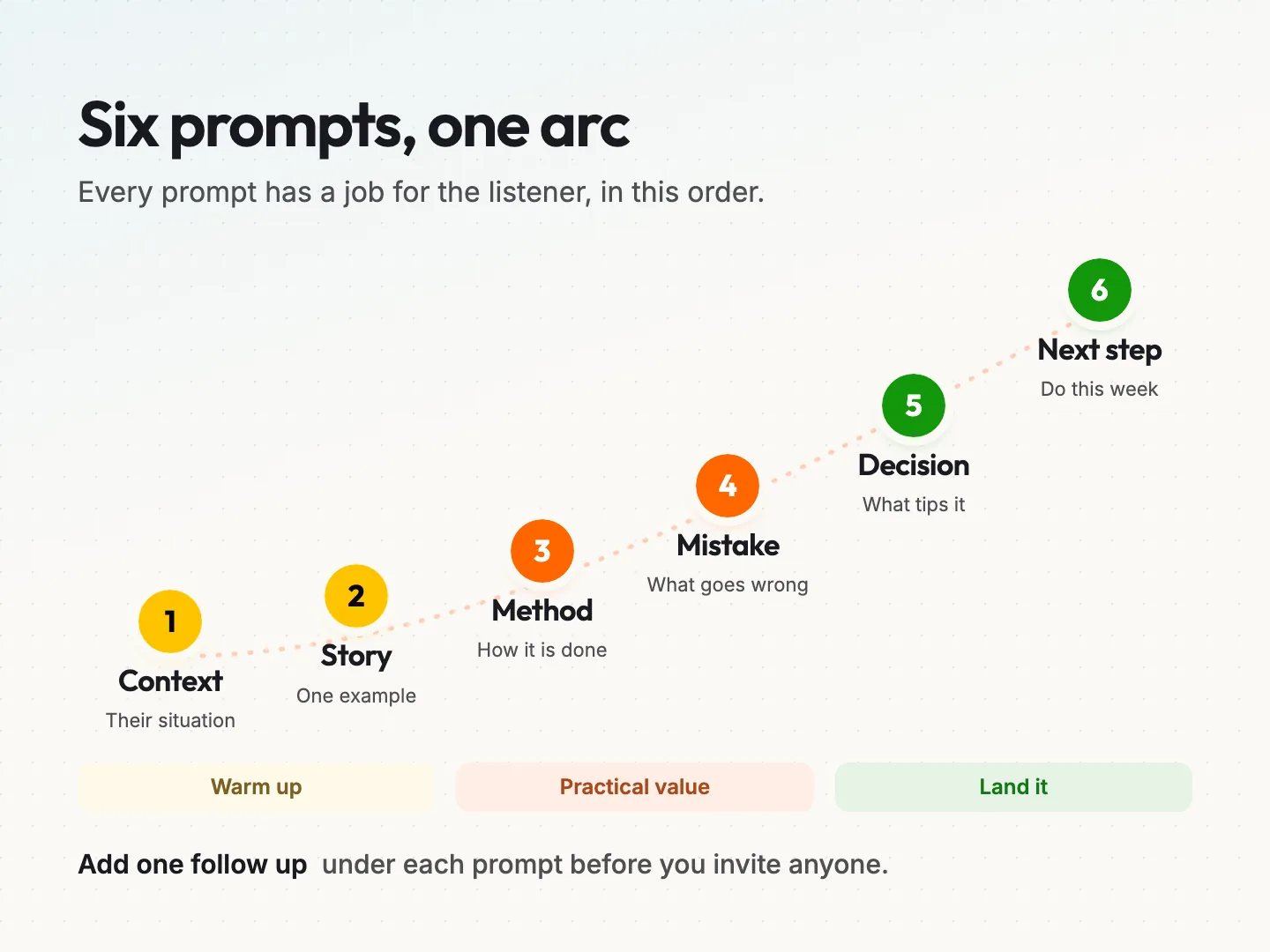
The six prompts, in order.
- Context. Ask the guest to describe the listener’s situation. “When a restaurant owner first looks at online ordering, what are they usually worried about?”
- Story. Ask for one specific example. “Tell me about a setup that went well or badly, without naming the business.”
- Method. Ask how the work is done. “Walk me through the first week of setting it up.”
- Mistake. Ask what goes wrong. “What is the most common error you see, and what does it cost the owner?”
- Decision. Ask for the deciding factor. “If someone is on the fence, what should tip them one way or the other?”
- Next step. Ask what the listener should do this week. “What is the first thing someone should check after this episode?”
The order matters. Context and story warm the guest up and give the listener a reason to care. Method and mistake carry the practical value. Decision and next step land the episode on the sentence you wrote at the start.
Add one follow up to each prompt.
Write one follow up under each prompt, such as “Can you give a rough range for that?” or “What would you do differently now?” You will not use all of them. They stop you from freezing when an answer is shorter than you expected.
Buzzsprout’s interview guide recommends open questions that invite stories over questions with a yes or no answer. Each of the six prompts above is open by design, and the story prompt asks for an example directly.
Decide what you will share with the guest.
Send the guest the topic, the angle and the six prompt themes. Keep the full wording for yourself unless the guest asks for it. Some guests prefer to prepare carefully, while others sound more natural when they have not rehearsed every answer.
Write the host copy for the opening, bridges and close.
Host copy is the short scripted text the host reads or paraphrases around the interview. It keeps the episode tied to the listener, even when the conversation goes somewhere unexpected. Buzzsprout’s guide to writing a podcast script (Alban Brooke, August 2026) lists the intro, guest introduction, segues and outro among the core parts.
The opening states the decision.
Write two to four sentences that name the listener and the decision. “If you run a small restaurant and you are wondering whether online ordering is worth it, this episode is for you. By the end, you will know the three costs to check first.” Then say in one sentence why this guest can help.
The guest introduction uses your own words.
Skip the pasted bio. Write two sentences on what the guest does and why it matters to this listener. The Podcast Host guide makes the same suggestion, noting that a bio in your own voice takes the pressure off the guest.
Bridges move between prompts.
A bridge is one sentence that links what the guest said to the next prompt. “That covers the setup. Now let’s talk about where it goes wrong.” Write one bridge between each pair of prompts. Bridges also give your editor clean places to cut.
The close repeats the next step and gives one call to action.
Restate the next step from prompt six in one sentence. Then give one call to action, such as visiting a page or booking a call. Buzzsprout’s script guide also advises keeping to one clear call to action, because more than one ask can overwhelm listeners.
Episode brief template you can copy.
Here is a brief you can paste into a shared document and fill in for every episode. Keep it to one page. If it grows longer, the episode is probably trying to do two jobs at once.
| Field | What to write |
|---|---|
| Working title | A plain title that names the decision. |
| Listener | Who is listening, in one line. |
| Listener decision | The choice or action they should be ready for. |
| Angle chosen | Method, mistake or choice, plus a one line route. |
| Angles parked | The other two angles, saved for later episodes. |
| Expertise needed | The specific experience the guest must have. |
| Guest shortlist | Two or three names, each with its fit check result. |
| Prompts 1 to 6 | Context, story, method, mistake, decision and next step, each with one follow up. |
| Opening | Two to four sentences naming the listener and decision. |
| Guest introduction | Two sentences in your own words. |
| Bridges | One sentence between each pair of prompts. |
| Close and call to action | The next step and one ask. |
| Permissions | What the guest has agreed to in writing. |
| Recording checks | Tracks, backup and sound check, each with an owner. |
| Repurposing plan | The clips, posts or articles you will make. |
Using the brief with a team.
Give one person ownership of the brief for each episode. The host fills in the decision, angles and prompts. Whoever books guests fills in the shortlist and permissions. Whoever edits fills in the recording checks and repurposing plan. Review it together once, before the invitation goes out.
Reusing the brief across a season.
Save each finished brief in one folder, named by episode number and decision. Before you plan a new episode, scan the parked angles from earlier briefs. You will often find your next decision sentence already waiting there.
A worked example of one hypothetical episode brief.
Here is the template filled in for a hypothetical bookkeeping firm that runs a podcast for restaurant owners. The firm, the guests and the details are invented to show the shape.
- Listener. Owners of independent restaurants with one or two locations.
- Listener decision. Whether to add online ordering this year, and which costs to check first.
- Angle chosen. Mistake: the fees and setup errors that reduce margin.
- Angles parked. Method (setting it up in the first month) and choice (apps or your own page).
- Expertise needed. Someone who has reviewed restaurant books before and after online ordering was added.
- Guest shortlist. A restaurant accountant, a former restaurant owner and a point of sale consultant.
- Prompt 4, mistake. “What is the cost owners most often miss, and where do they find it on a statement?”
- Close. “Pull last month’s statement and find the three costs we covered. If you want help reading it, book a call.”
Notice that the guest shortlist came late in the process. The firm knew exactly what it needed, so it could explain the request in one email. A guest who receives a clear angle and six prompt themes can say yes or no quickly.
Prep the guest once the brief is approved.
With the brief done, the invitation almost writes itself. Tell the guest who the listeners are, which decision the episode supports and why their experience fits. Include the format, the expected length, a few recording date options and how the episode will be used.
Hold a short pre interview call.
A pre interview is a brief call before recording to check fit and settle details. Use it to confirm the angle, hear one or two stories the guest might tell and agree on anything that is off limits. The Podcast Host guide also suggests asking what would make the episode a success for the guest. That question often surfaces the story worth building around.
Send a short confirmation note.
After the call, send one message with the date, time, link, the six prompt themes and what the guest has agreed to. Ask the guest to reply to confirm. That reply becomes part of your permissions record.
Confirm permissions and recording checks before the call.
Permissions are the guest’s agreement about how their voice, image and words can be used. Recording checks are the technical steps that make sure you capture usable audio. Both are far easier to settle before the call than after it.
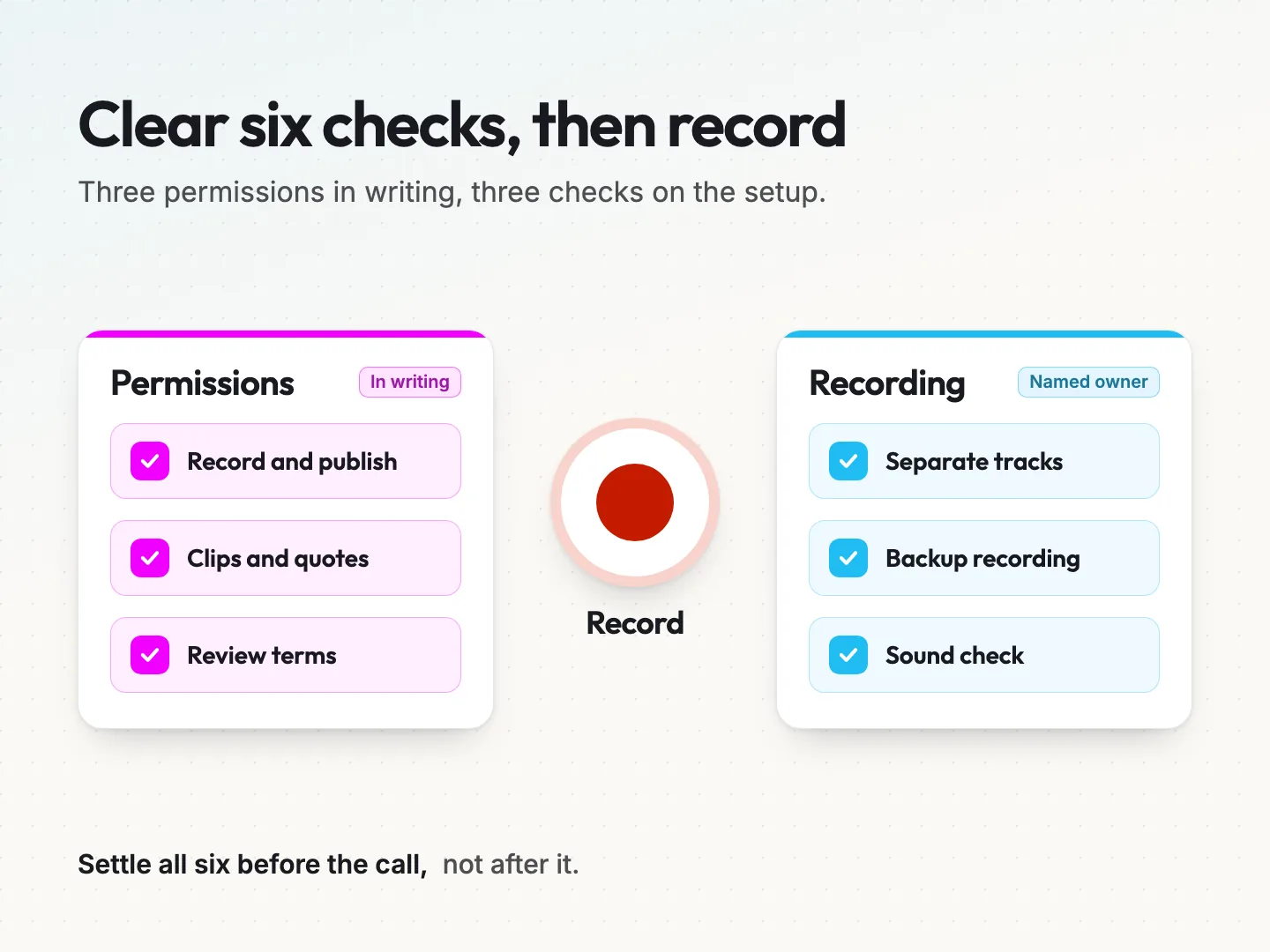
Get three permissions in writing.
- Record and publish. The guest agrees to be recorded, in audio, video or both, and to the full episode being published.
- Clips and quotes. The guest agrees to short clips, quotes and transcripts appearing in social posts, emails and articles.
- Review terms. You state whether the guest can review the edit, and what they can ask you to change.
Rules on recording consent and the use of a person’s voice or likeness vary by location. This guide is not legal advice. Ask a lawyer to review your release wording once, then reuse it for every episode.
Run three recording checks.
- Separate tracks. Record each speaker on their own track, so you can fix one voice without touching the other.
- Backup recording. Run a second recording, such as a local recording on each side or a phone in the room.
- Sound check. Do a short test with the guest’s actual microphone and room before you start.
Write the name of the person responsible next to each check. A check with no owner tends to be skipped on the day.
Use the brief during the recording and the edit.
Keep the brief open while you record. Tick off each prompt as it is covered, and glance at the decision sentence whenever the conversation drifts. A good tangent can stay, but only if it still helps the listener with that decision.
Steer back with the prompt’s job.
When an answer wanders, you do not need to interrupt. Wait for a natural pause, then use the bridge you wrote. Because each prompt names what the listener should get, you can ask for it directly, such as “So what should an owner check first?”
Edit against the decision sentence.
In the edit, every section has to earn its place against the sentence at the top of the brief. Keep the parts that move the listener toward the decision. Cut or trim the rest, even when it was entertaining. If a cut tangent was genuinely useful, add it to the parked angles list.
Plan the content you will make from the episode.
A planned episode is easier to reuse, because you already know its main points. The six prompts can become section headings for a blog post, the mistake answer a short clip and the next step an email. Plan how to turn the episode’s main points into written sections before recording.
If you also film the episode, the same planning helps your video. The host copy works as a starting outline for the scene-by-scene video script. Episodes built around a lasting decision also age well, which is the idea behind creating evergreen content.
Write the repurposing plan into the brief before recording. Then you can ask the guest, during the pre interview, for the one story that will work best as a clip.
Common podcast planning mistakes to avoid.
- Booking first, planning later. The episode ends up shaped around the guest’s calendar and agenda.
- A topic instead of a decision. Broad topics produce broad conversations that are hard to edit.
- One angle only. Without alternatives, you cannot tell whether the angle you picked is the strongest.
- Questions with no job. A long list of questions gives no direction. Six prompts with clear jobs do.
- No close. The episode ends with thanks and goodbye, and the listener gets no next step.
- Permissions by memory. A spoken yes is easy to forget or dispute later. Get it in writing.
Final thoughts on podcast episode planning.
Good podcast episode planning is mostly a change of order. Decide what the listener should be ready to do, choose the angle, then write the prompts and host copy. Only after that do you invite the guest who fits. The brief template holds the whole plan on one page, so your host, booker and editor all work from the same document.
Start with your next episode. Write the listener decision sentence today, and draft three angles before you contact anyone.
Want help planning a show that supports your marketing? Our content marketing team can build the briefs with you, and our video marketing team can help on camera. When you are ready, talk to a specialist about your podcast plan.
Was this article helpful?