Good discovery call questions find out why the buyer is looking now, how they handle the problem today, what waiting costs them, who decides and what they can decide next. Plan the whole call around that last answer. A discovery call works when it ends with one small decision the buyer agrees to make.
A discovery call is the first real conversation with a possible customer. You learn their situation, and they learn whether you understand it. Most guides hand you a long list of questions. This one gives you a plan instead. You will get questions for each part of the call, a prep prompt you can copy, answers to common objections and a simple record of what was agreed.
The advice is written for owners and small sales teams who sell services. You probably run your own calls, and you do not have a sales manager reviewing every deal. That is fine. A short, honest structure does more for you than a script.
The real job of a discovery call.
A discovery call has two jobs. You find out whether you can help, and you help the buyer take the next step in their own decision. It is not a pitch, and it is not a demo. Those come later, once you know what matters to them.
Many calls go wrong because the seller treats them as a test the buyer must pass. The buyer feels questioned, gives short answers and leaves with nothing new. A better call feels like two people working out a problem together. The buyer should leave knowing something they did not know when they joined.
It helps to separate discovery from qualification. Qualification asks whether this lead fits your business at all. Discovery goes deeper into the problem, the people and the decision. If you need help with the first part, our guide to using the RevOps AI skill for lead qualification covers how to sort leads before you book a full call.
Decide the buyer’s next decision before the call.
Before you write a single question, write one sentence. What could this buyer reasonably decide by the end of this call? Not “buy from us”. Something smaller and real, such as booking a site visit or bringing the person who controls the budget to the next meeting.
Buying is rarely one decision. It is a ladder of small ones. The buyer agrees to talk, then shares the real problem, then brings in the person who decides, then reviews a proposal, then approves a budget, then signs. Each rung is a separate yes.
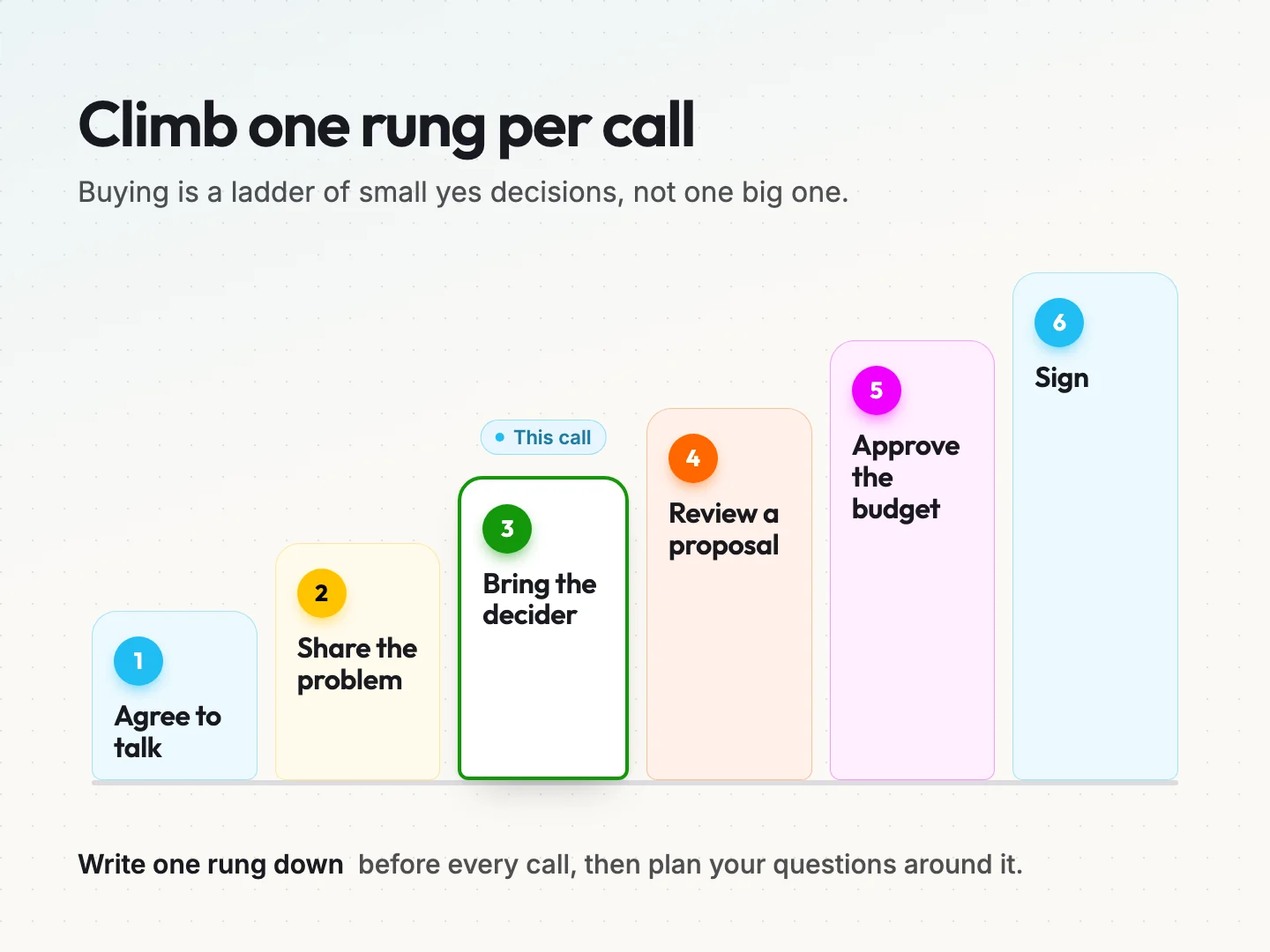
Your job on any one call is to help the buyer climb one rung. When you know which rung you are on, your questions get sharper. You stop asking about budget on a first call where the buyer has not even described the problem yet.
Here is a quick way to pick the rung.
- First contact, problem unclear. Aim for the buyer to describe the problem in their own words and agree to a second conversation.
- Problem clear, decider unknown. Aim for the buyer to name who decides and invite that person to the next call.
- Decider involved, scope unclear. Aim for agreement on what a proposal should cover and when it will be reviewed.
- Proposal sent, no reply. Aim for a short call to review it together, or a clear no.
Write your chosen decision at the top of your notes. Everything else on the call either supports it or can wait.
Discovery call questions for each part of the call.
A 30-minute discovery call has five parts. You do not need to follow them rigidly, but this order feels natural to most buyers. Each part has a few questions and a reason to ask them.
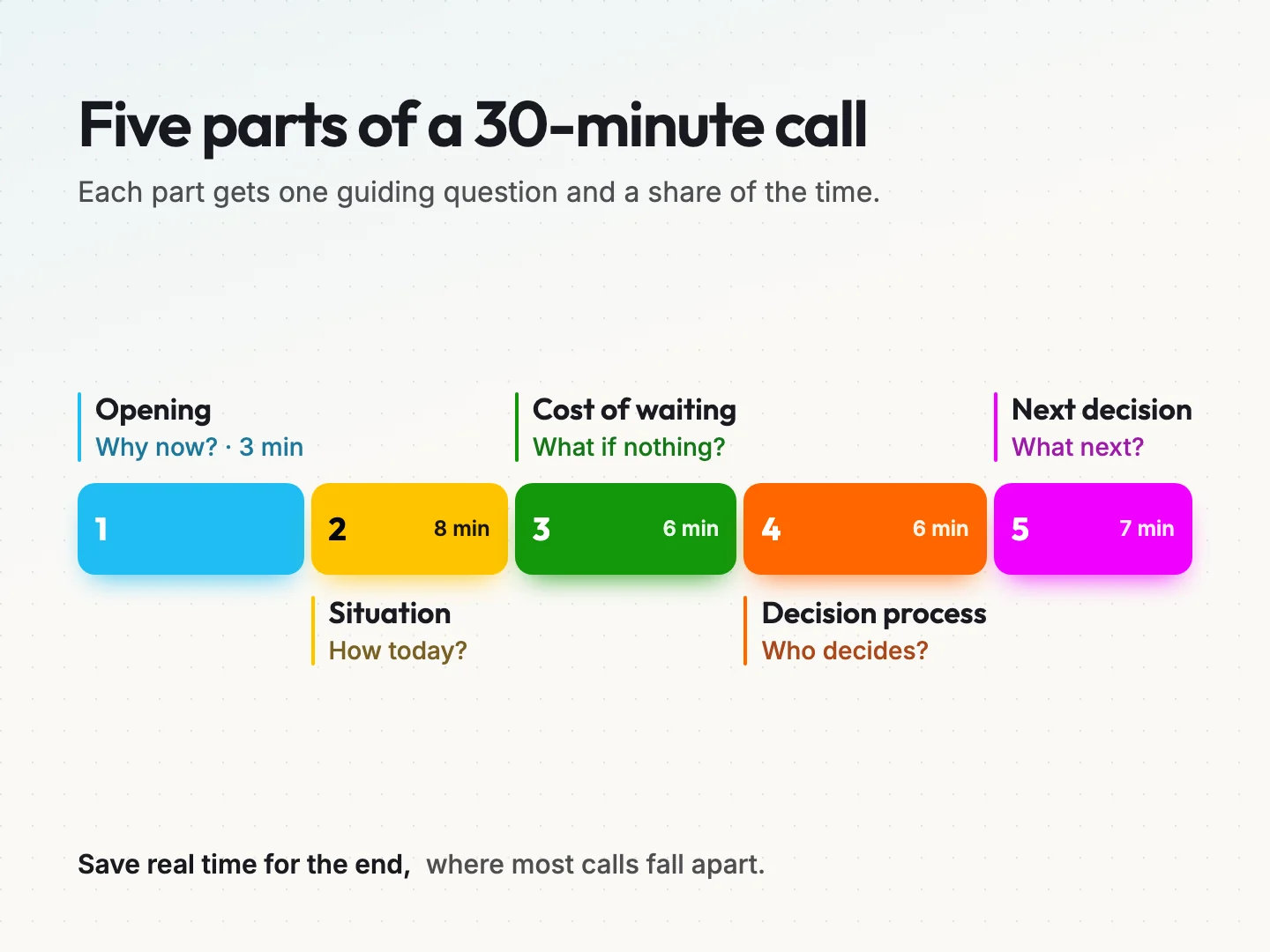
A rough split of the time looks like this. Use 3 minutes to open, 8 minutes on the current situation, 6 on the cost of waiting, 6 on the decision process and 7 on the next decision. The last part gets more time than people expect, because it is where calls usually fall apart.
Opening: why now?
Start by confirming the time you have and what you hope to cover. Then ask what started the conversation. Something changed, or they would not be talking to you.
- “What made this a priority now rather than six months ago?”
- “When you searched for help, what were you hoping to find?”
- “Before we start, is there anything you need to get out of this call?”
The answer to the first question can tell you more than the rest of the call. A new location, a lost customer or a frustrated partner each lead to a different conversation.
Current situation: how does it work today?
Ask how they handle the problem right now. Keep it concrete. You want to hear the actual steps, the people and the tools, not a summary.
- “Walk me through what happens today, from the first step to the last.”
- “Who does that work, and how much of their week does it take?”
- “What have you already tried, and what happened?”
Do your homework before the call so you never ask what their website already answers. Use this part to learn what only they can tell you.
Cost of waiting: what happens if nothing changes?
This is where a buyer decides whether the problem is worth solving now. Ask gently. You are not trying to scare anyone.
- “If this stays the same for another year, what does that cost you?”
- “Who else in the business feels this problem?”
- “Where does this sit against your other priorities this quarter?”
If the honest answer is “not much”, believe it. A problem that costs little is a problem the buyer will not pay to fix soon. Knowing that early saves you both time.
Decision process: who decides and how?
Small businesses often have one decider. Mid-size businesses may have two or three people with a say. Ask early, before you build anything for them.
- “Besides you, who will have a say in this?”
- “How did you make the last decision like this one?”
- “What would you need to see to feel comfortable choosing someone?”
The second question is useful because it asks about a real event, not a hypothetical process. People describe what happened much more accurately than what they think should happen.
Next decision: what can we agree now?
Return to the sentence you wrote before the call. Offer the next step and ask whether it makes sense to them.
- “Based on what you have shared, would it help to [next step] by [date]?”
- “What would you need from me before that meeting?”
- “Is there anything that would stop that from happening?”
The last question catches problems while you can still solve them. It is much easier to hear “my partner is away until the 20th” now than to discover it after a week of silence.
The discovery prep prompt you can copy.
An AI assistant can help you prepare in a few minutes, as long as you give it real facts and clear limits. The prompt below turns your notes about a buyer into a short call plan. Copy it, replace the parts in square brackets and paste it into the assistant you use.
“`text You are helping me prepare for a sales discovery call. Use only the facts below. Do not invent details about the buyer, their business or their numbers.
What I sell: [your service in one sentence]. Buyer and role: [name or role, company type, size]. How they found us: [referral, search, ad, event]. What I already know: [facts from their website, form or email]. Where they are in the decision: [first contact, problem clear, decider involved, proposal sent]. The next decision I hope they can make: [one small, specific step].
Please give me: 1. Three opening questions about why they are looking now. 2. Four questions about how they handle the problem today. 3. Two gentle questions about the cost of waiting. 4. Three questions about who decides and how. 5. A one-sentence way to offer my next decision. 6. The three objections they are most likely to raise, with one question I could ask about each.
Keep every question short and open. Avoid jargon. After the plan, list anything you assumed that is not in the facts above. “`
The last line is the most important. AI tools sometimes fill gaps with details that sound right but are not true. Asking for a list of assumptions shows you exactly where to check. Delete anything you cannot confirm.
Treat the output as a draft. Cut questions that sound unlike you, and keep the list short enough to fit on one page. If you want a ready-made writing assistant for the sales copy that follows the call, our sales copywriting AI skill is built for proposals and follow-up emails.
A hypothetical discovery call from start to finish.
Here is a hypothetical example to show the questions in use. A small commercial cleaning company is talking to the operations manager of a property firm that manages four office buildings. The seller’s goal for this call is for the buyer to agree to a walkthrough of one building.
Opening. The seller confirms they have 30 minutes and asks what prompted the call. The manager explains that tenants in one building have complained twice this month, and the current contract renews in eight weeks.
Current situation. The seller asks how cleaning is checked today. The manager says nobody checks it. Complaints arrive by email to the front desk, and the manager hears about them days later.
Cost of waiting. The seller asks what happens if the complaints continue. The manager says one tenant has mentioned the issue in a lease conversation. That is the real worry.
Decision process. The seller asks who else has a say. The manager names the regional director, who signs contracts above a set amount. The last vendor change took about a month, mostly waiting for the director’s review.
Next decision. The seller suggests a walkthrough of the building with complaints, with the director invited for the last 15 minutes. The seller asks whether anything could stop that. The manager says the director travels next week, so they pick the following Tuesday.
Notice what the seller did not do. There was no price, no service list and no long pitch. The call ended on one rung of the ladder, with a date and the right person invited.
Handle sales objections without arguing.
An objection is a reason the buyer gives for not moving forward. It is rarely the whole story. Usually it protects something the buyer has not said yet, such as a budget limit, a past bad experience or a worry about switching.
When you hear an objection, resist the urge to answer it straight away. Ask one question first. The aim is to find out what the objection protects, and then respond to that.
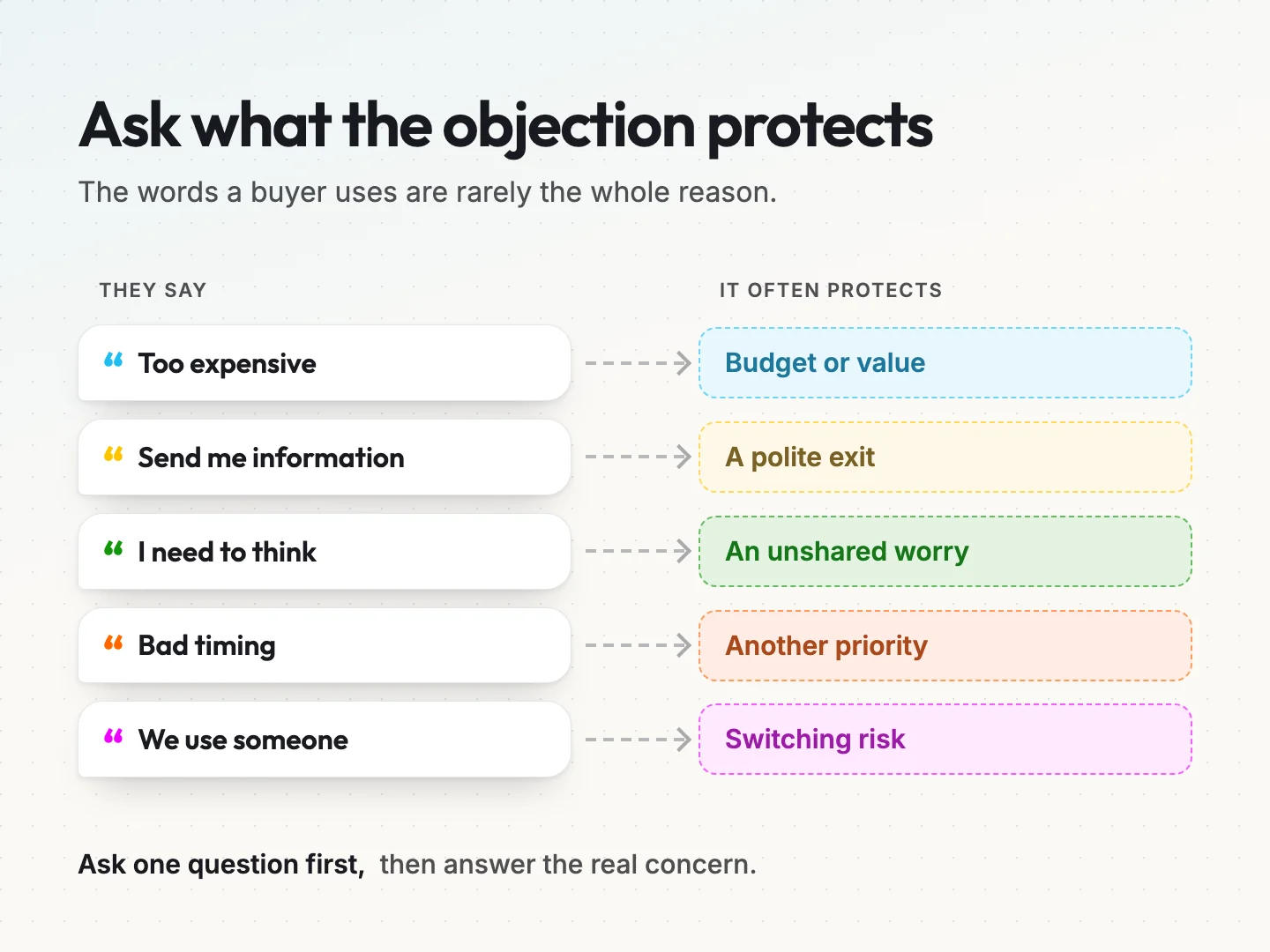
| What the buyer says | What it often protects | A question to ask first | A calm answer |
|---|---|---|---|
| “It’s too expensive.” | A budget limit, or doubt about the value. | “Is it the total, or how it is paid?” | Offer a smaller first phase or explain what the price includes. |
| “Send me some information.” | A polite way to end the call. | “What would you look for in it?” | Send one page on that point and book a time to discuss it. |
| “I need to think about it.” | A worry they have not shared. | “What part are you still unsure about?” | Answer that part directly, then agree when to talk again. |
| “The timing is bad.” | Another priority comes first. | “What needs to happen before this makes sense?” | Agree a date to check back, tied to that event. |
| “We already use someone.” | The risk and effort of switching. | “What would have to be true for a change to be worth it?” | Explain the handover plainly, including what could go wrong. |
Sometimes the honest answer is that you are not the right fit. Say so. A buyer who hears “this may not be right for you, and here is why” often remembers you when the situation changes.
Practice helps more than any table. If you work with a team, record one call with permission and review it together to practice the conversation.
End the call with one agreed next step.
A next step is not “I’ll follow up next week”. It is a specific action that both sides agree to, with a date.
Salesmotion’s guide to sales next steps, published in July 2026, describes a qualified next step as having five parts. It is written mostly for larger sales teams. Those parts are a specific action, a buyer deliverable, a date and time, one owner on each side and a benefit the buyer can explain internally.
For a small business, that list can be shorter. Check three things before you hang up.
- The action. What exactly happens next, in a sentence the buyer would repeat to a colleague.
- The owners. One person on their side and one on yours.
- The date. A real calendar date, ideally booked while you are both still on the call.
If the buyer will not agree to any next step, that is useful information too. Ask what would need to change for a next step to make sense. Then write down the answer and respect it.
Write down what the buyer agreed.
Many stalled deals share one problem. The seller remembers a different call from the one the buyer remembers. The seller heard enthusiasm. The buyer heard a pitch and agreed to nothing in particular.
A short written recap fixes this. Send it the same day, and keep it to what was said. Do not add promises the buyer did not make.
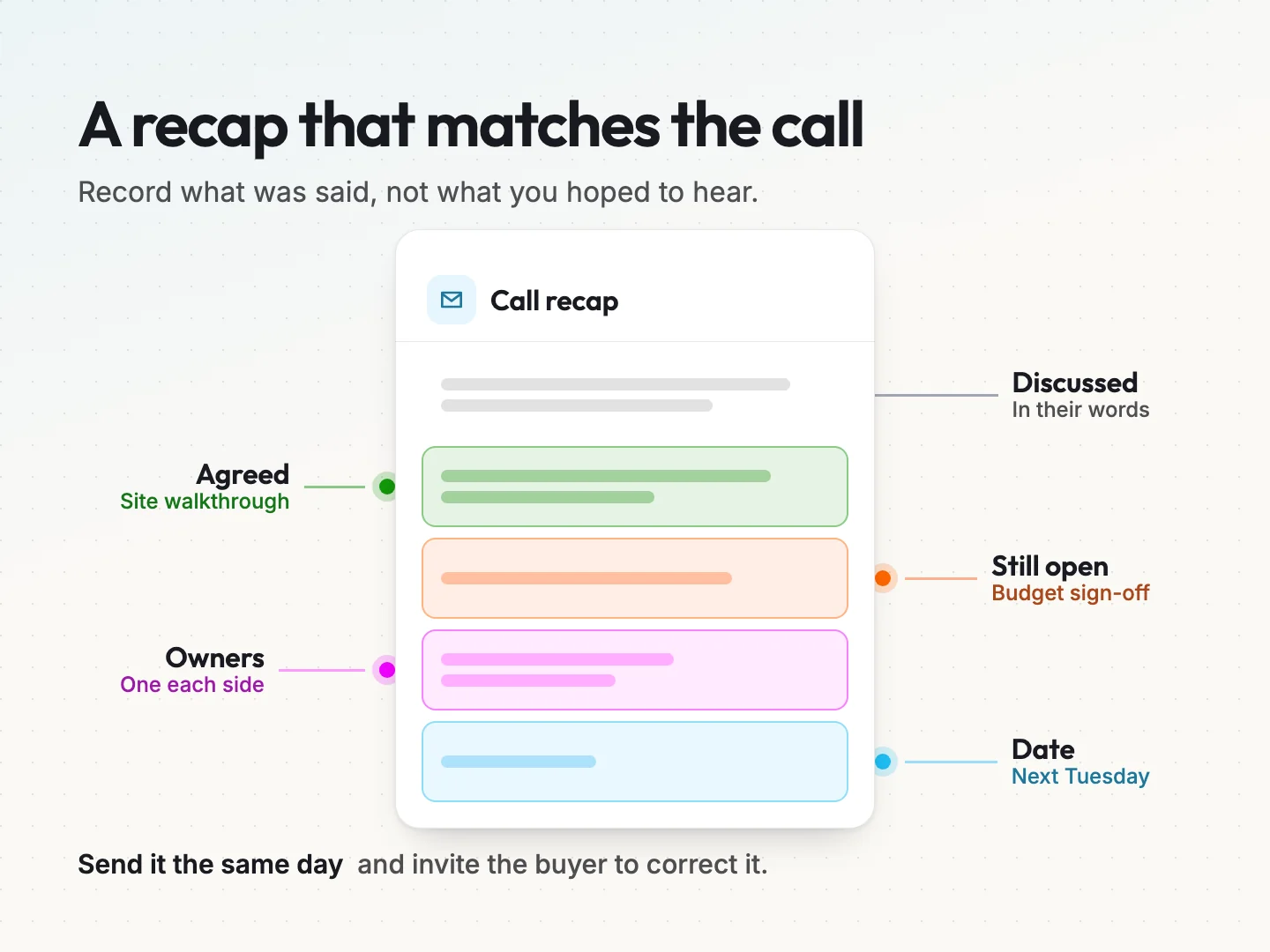
Use this recap template.
- What we discussed. Two or three sentences in the buyer’s words.
- What we agreed. The next step, exactly as agreed.
- What is still open. Anything you did not settle, such as budget or who else needs to join.
- Owners. Who does what on each side.
- Date. When the next step happens.
Then end with one line, such as “If I have anything wrong here, reply and I’ll correct it.” That invites the buyer to fix your record before it causes problems.
Keep the same record in your CRM, the software that stores your customer conversations. If you use pipeline stages, move the deal only when the buyer has agreed to the step that defines the next stage. Our guide to defining pipeline stages with the RevOps AI skill explains how to set those rules.
Stalled proposal follow-up that respects the buyer.
A stalled proposal is one the buyer received but has not answered. It happens to everyone. The fix is rarely a stronger closing line. It is usually a smaller next step, based on what the buyer agreed.
Here is a simple follow-up sequence. Adjust the timing to your sales cycle.
- Two days after the agreed review date. Refer back to the recap. “We agreed you’d review the proposal with your director by Friday. Did you get a chance, or would a short call help?”
- One week later. Offer a smaller decision. “Would it help to start with one building first, so you can see the work before committing to all four?”
- Two weeks after that. Ask whether to close the file. “I don’t want to keep filling your inbox. Should I close this for now and check back in a few months?”
The third message is worth sending. It gives the buyer permission to say no, and many people find that easier than saying nothing. A clear no is better than months of silence, because it frees your time for buyers who are ready.
Never invent urgency to restart a stalled deal. False deadlines and surprise discounts damage trust, and buyers usually notice. Base every follow-up on something the buyer said or agreed.
Discovery call mistakes that stall deals.
A few habits cause many stalled deals. Each one is easy to fix once you notice it.
- Pitching too early. If you describe your service in the first ten minutes, the buyer stops sharing and starts evaluating.
- Asking too many questions. A call is not an interview. Pick the questions that serve your next decision and skip the rest.
- Accepting vague answers. “We need better results” is a starting point. Ask “What would better look like?” until you hear something specific.
- Ignoring the decider. If the person who signs never joins a call, your proposal competes with every other email they receive.
- Leaving without a date. “Let’s talk soon” almost always means the deal has paused.
- Not writing anything down. Without a recap, you cannot follow up on what was agreed, only on what you hoped.
If calls keep stalling at the same point, look at the pattern rather than the individual deal. You may be on the wrong rung of the ladder, asking for a proposal review when the buyer has not yet agreed the problem is worth solving.
Some businesses handle enough enquiries that preparation and follow-up become a job of their own. An AI sales assistant can draft call plans from form submissions, log recaps and remind you when a follow-up is due. A person should still run the conversation and approve anything sent to the buyer.
Final thoughts on discovery call questions.
The best discovery call questions are not clever. They are specific to the buyer, asked in a sensible order and aimed at one decision the buyer can make next. Write that decision down before you dial, and the rest of the call gets easier.
End every call with one agreed step, an owner on each side and a date. Send a recap the same day. When a proposal stalls, follow up on what was agreed, offer a smaller step and give the buyer an easy way to say no.
If you want help building a sales process that keeps calls moving, from prep prompts to follow-up automation, talk to a specialist about what would fit your team.
Was this article helpful?